Key facts
- Governor Mykhaylo Semikin said the death toll from the November 2 strike on Komyshuvakha reached 53.
- Search and rescue operations at the site have continued for five days, with the final toll not yet established.
- One of the bombs was a 3-ton FAB-3000 carrying more than 1,000 kilograms of explosives.
- President Volodymyr Zelensky said Russian forces dropped another nine aerial bombs on a shelter holding civilians and rescue workers.
- Two rescue workers and a military medic who went to help the wounded were among those killed.
- Zelensky condemned the attack as "exceptionally horrific" and said Russian forces could not have been unaware civilians gathered there.
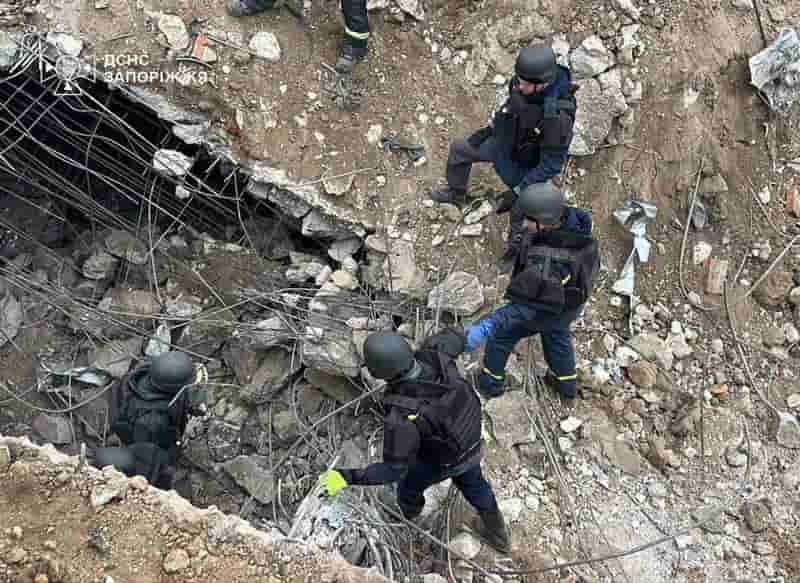
The death toll from Russia's November 2 aerial bomb attack on the village of Komyshuvakha in Zaporizhzhia Oblast rose to 53, Governor Mykhaylo Semikin said on November 6. Search and rescue operations at the site have continued for five days, with the final death toll yet to be established.
Russian forces struck the front-line village several times on November 2, initially hitting a school building where local residents had gathered to receive humanitarian aid. One of the bombs was a 3-ton FAB-3000, containing more than 1,000 kilograms of explosives.
Following the initial strike, Russian forces dropped another nine aerial bombs on a shelter where civilians and rescue workers had taken refuge, President Volodymyr Zelensky said. Two rescue workers and a military medic who rushed to help the wounded were among those killed.
Zelensky condemned the attack as "exceptionally horrific," saying Russian forces could not have been unaware that civilians regularly gathered at the site to receive humanitarian aid. The strike was the deadliest Russian attack on Zaporizhzhia Oblast since the start of the full-scale invasion, according to the report.
Komyshuvakha is a front-line settlement that was home to around 5,000 people before the full-scale invasion. The security situation has deteriorated sharply over the past six months, with the last remaining children evacuated in June, according to local authorities. The attack came just a day after a six-day ceasefire in the Russian-occupied town of Oleshky in neighboring Kherson Oblast ended on November 1.