Key facts
- China is systematically studying and adopting drone warfare tactics from the Ukraine conflict.
- Military and defense industry analysts typically identify new battlefield techniques within about four months.
- Lessons are appearing in PLA training, equipment, or force structure within about a year, a faster pace than before.
- Chinese analysts consider electronic warfare a deciding factor in drone warfare.
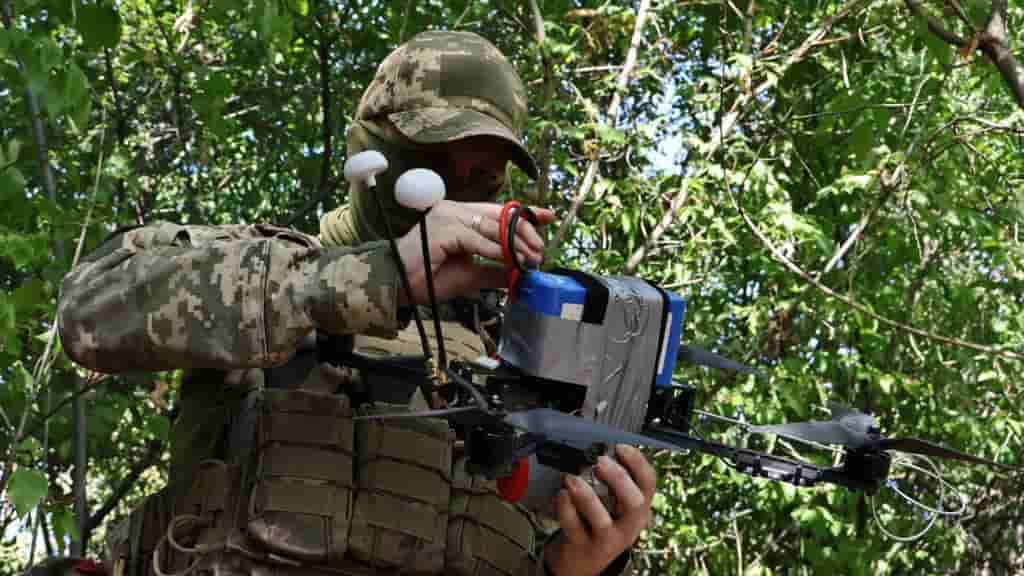
- The PLA is developing cost-effective, expendable drones for saturation attacks and FPV drones for reconnaissance and close-range strikes.
- China's industrial strength in commercial drone manufacturing aids its rapid integration of drone technology.
China is undertaking a systematic effort to learn from the drone warfare tactics employed in the Russia-Ukraine conflict, with military and defense industry analysts identifying new battlefield techniques within approximately four months. This accelerated pace of adoption is significantly faster than in previous years, when it typically took a year or more for such lessons to manifest in the People's Liberation Army's (PLA) training, equipment, or force structure.
According to an analysis by Lilly Min-Chen Lee and Kateryna Bondar, China's study of the drone war is distributed across various channels. Military structures feed lessons from their journals into design institutes and service requirements, while the Central Military Commission's press facilitates doctrinal debate, and state media broadcasts conclusions. This structured approach categorizes lessons into offense, defense, organization, industry, and unproven concepts, each processed through different channels at different speeds.
In offensive tactics, China is observing Russia's combat-tested methods, which resemble the PLA's own structure. Economically, the PLA Daily has stated that a single reconnaissance-strike drone costs less than 1 percent of a modern fighter while achieving over 90 percent of its battlefield coverage. Russian forces can reportedly strike a detected target within three to five minutes, attributed to a reconnaissance-strike complex where a low-cost drone guides another drone's attack. Chinese analysts also highlight electronic warfare as a critical factor, noting the rapid adoption of fiber-optic FPV drones, which are less susceptible to jamming, within weeks of their operational debut.
Defensively, Chinese analysts are studying Ukrainian methods, particularly sea drones, and developing counter-sea drone equipment. The PLA is also focusing on developing cost-effective, expendable drones for saturation attacks and FPV drones for reconnaissance and close-range strikes. The PLA Air Force has announced a competition for designing cheap UAVs with capabilities including autonomous navigation, precision targeting, and swarm coordination. China's extensive industrial capacity in commercial drone manufacturing is seen as a significant advantage in rapidly deploying these solutions.