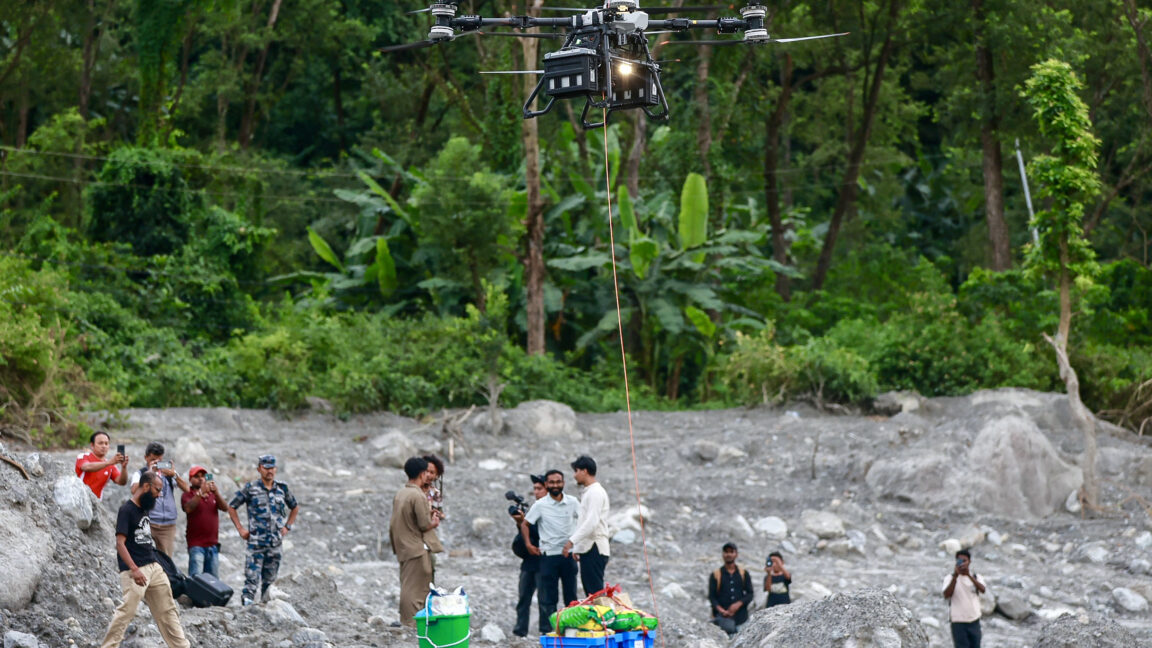
Key facts
- Chinese-made drones are airlifting bodies of flood victims and delivering food in Nepal.
- Nepal's army is using four DJI FlyCart 100 drones donated by China.
- The drones are making 10 to 16 aid deliveries daily.
- The drones can carry between 187 and 220 pounds, but are currently hauling about 132 pounds of supplies.
- As of September 9, Nepal's official death toll was 1,369, with over 5,000 people missing.
- The drones have distributed 1,591 kilograms of food items across 31 flights.
Chinese-made drones are playing a critical role in the aftermath of devastating flash floods on the border of Nepal and China's Tibetan region, aiding in the delivery of essential supplies and the recovery of victims' bodies. The Nepal army has deployed four DJI FlyCart 100 drones, donated by China, to transport food and other aid to survivors in remote areas inaccessible due to the disaster.
The floods, triggered by a partial glacier collapse in the Himalayas on August 26, swept through communities and infrastructure, including hydropower projects. The heavy-lift capability of the DJI FlyCart 100 drones, which can carry up to 220 pounds, has enabled them to transport approximately 132 pounds of supplies per trip. This capacity has also been utilized to retrieve the bodies of flood victims from affected areas.
As of September 9, the official death toll in Nepal had reached 1,369, with over 5,000 people, including 587 foreign nationals, still reported missing. The drones have facilitated the distribution of 1,591 kilograms of food items. The United Nations has launched an appeal for $20.5 million to assist the 43,000 people impacted by the disaster.
Smaller drones have also been instrumental in search-and-rescue operations, with over 21,000 police and soldiers deployed. Drone pilots have navigated challenging environments, such as hydropower tunnels filled with mud, to locate trapped workers. In some instances, drones equipped with speakers were used to communicate with survivors, aiding in their rescue.