Key facts
- Blue Origin said Northstar has half the parts and 30 percent less mass than the BE-4 engine it will replace.
- Blue Origin believes it can build Northstar at 25 percent of the cost of a BE-4 engine.
- Limp said Northstar will start at 715,000 pounds of thrust, against 640,000 pounds for the BE-4.
- Blue Origin said a GS3-equipped New Glenn 7x2 can carry 8 metric tons directly to geostationary orbit.
- Blue Origin said it will keep making the BE-4 engine for United Launch Alliance's Vulcan rocket.
- Blue Origin is aiming for a GS3 debut in 2028 for a government customer, Limp said.
Blue Origin announced two upgrades to its New Glenn rocket on November 5, 2026, at the UP.Summit conference at the Shuttle Landing Facility in Florida, saying they would cut manufacturing cost and expand payload capacity to geostationary orbit and the Moon. The company said it aims eventually to position New Glenn to launch more than 1,000 times a year.
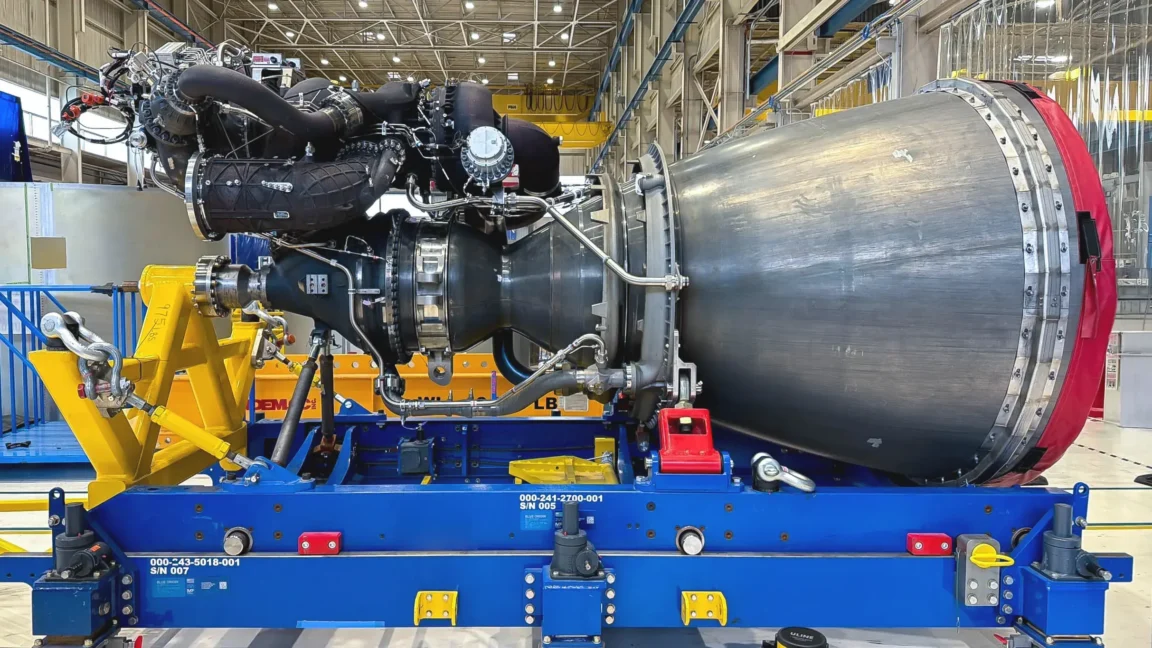
Chief executive Dave Limp said a new engine called Northstar, already in a test-firing campaign, will eventually replace the BE-4 that powers New Glenn's first stage. He described it as a simplified but more powerful version of the BE-4, with half the parts, 30 percent less mass and about 65 percent able to be 3D-printed. Blue Origin believes it can build the engine at 25 percent of the cost of a BE-4 and eventually assemble each in less than a day.
Limp said the BE-4 has a thrust of 640,000 pounds and Northstar will start at 715,000 pounds. Like the BE-4, Northstar burns methane and liquid oxygen. Blue Origin will keep making the BE-4 for United Launch Alliance, whose Vulcan rocket uses two of them.
Separately, Blue Origin said it is developing a hydrogen-oxygen third stage, GS3, for direct injection to geostationary orbit and Earth-escape trajectories. It fits within an interstage, preserving full fairing volume, and can fly on both the 7x2 and 9x4 variants of New Glenn. According to Blue Origin, a GS3-equipped 7x2 can carry 8 metric tons directly to geostationary orbit and 10 metric tons to translunar injection; the 9x4 figures rise to 14 tons and 20 tons.
The stage is made mostly of composites to keep it light and will be powered by the BE-7 engine already used on the company's lunar landers. Limp said hydrogen's small molecule makes it leaky and that thermal cycling and mechanical strain can crack composite tanks. He said the company was unsure a 5.5-meter composite tank could hold hydrogen at high pressure.
Blue Origin said it completed its first composite liquid hydrogen tanking test at Launch Site One in Texas, pressurizing the tank to 100 percent of the maximum expected operating force for 2.5 hours and to 150 percent for 10 minutes. Limp said the company is aiming for a GS3 debut in 2028 for a government customer, adding: "We have one customer signed up for cislunar space in 2028."