Key facts
- Bezos said picking a villain is a good political technique but a terrible technique for solving problems.
- Bezos said Big Tech is now the villain in a picture that is being painted and that it is not correct.
- Bezos said most people in tech just want to stay heads down doing the work.
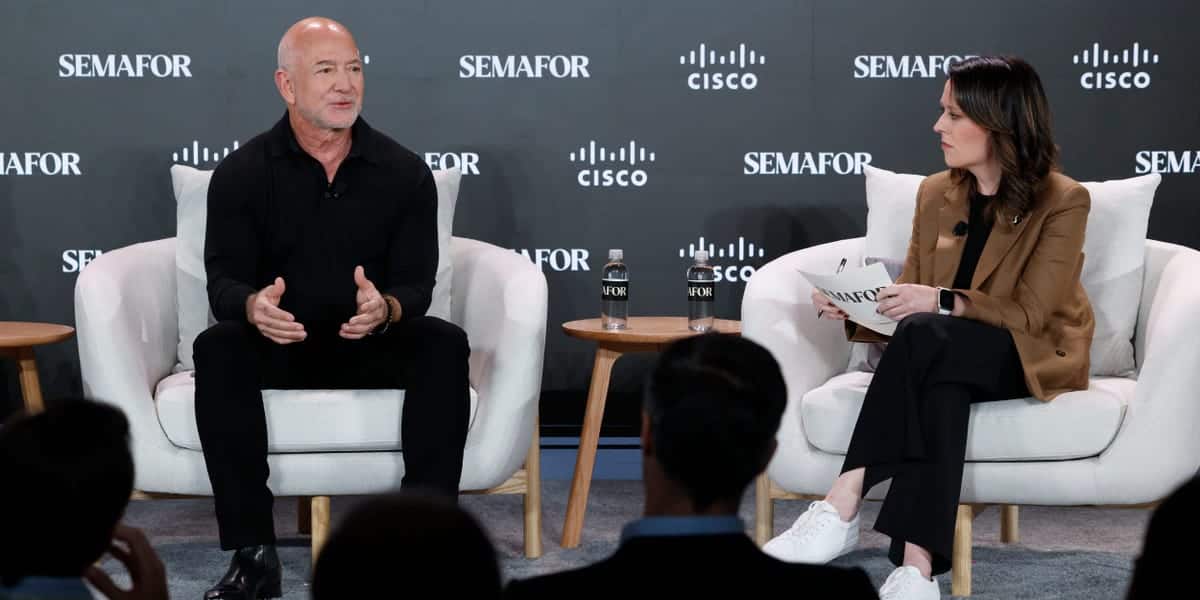
- Bezos spoke with Semafor's Liz Hoffman at the Semafor Silicon Valley & The World conference.
Jeff Bezos said on November 17, 2026, that politicians are making Big Tech the latest villain as voters focus on affordability, speaking with Semafor's Liz Hoffman at Semafor's Silicon Valley & The World conference.
"That is the age-old political technique, which is pick a villain," Bezos said. "And pick a villain is a good political technique, but it's a terrible technique for solving problems."
Bezos said public perceptions of powerful industries have shifted over time, from lawyers to Wall Street to landlords, and now it is Big Tech's turn. "From time to time, landlords are the villains. And now, Big Tech is the villain. Tech is the villain," he said. "That is the picture that is being painted. It's not correct. It's not a true picture."
"I think most people in tech just want to stay heads down doing the work. I don't think there's a lot of villainy here," Bezos added.
His comments come as Big Tech faces public scrutiny over its expanding footprint in everyday life, from data centers that can drive up local utility costs to AI surveillance tools such as Flock's network of license-plate-reading cameras. Concerns about privacy, energy costs and the impact of AI on jobs have fueled resistance to the industry's growing influence.
Those concerns have intersected with a broader affordability backlash. Higher household costs, including war-related pressure on fuel and some consumer prices, and persistently high housing costs weighed on voters in the 2026 midterm elections.
In ABC News' election polling, 89% of voters said the cost of living was a crucial or major factor in their vote. Affordability concerns have become a defining political issue, helping Democrats flip key seats and win majorities in both chambers of Congress in the latest election.
Economic anxiety cut across party lines. Some Democrats who won, including Abdul El-Sayed in Michigan and James Talarico in Texas, made data-center development and AI's potential effects on workers part of their campaigns.