Key facts
- The BepiColombo mission, a joint ESA-Japan effort, has jettisoned its propulsion module.
- This maneuver occurred 39 million miles from the Sun, marking a critical step before orbit insertion.
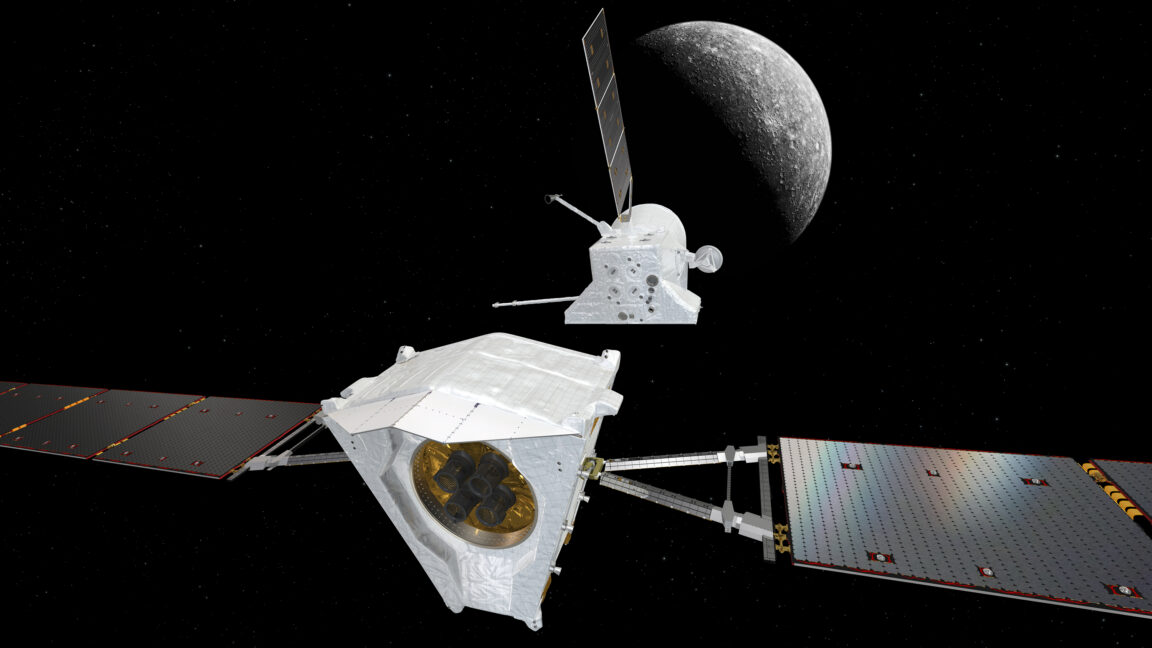
- The separation of the Mercury Transfer Module leaves the two science orbiters traveling together.
- BepiColombo is scheduled to enter orbit around Mercury on November 21, after an eight-year journey.
- The mission experienced a partial loss of power to its ion thrusters in 2024, extending its cruise.
The BepiColombo mission, a collaborative effort between the European Space Agency (ESA) and Japan, has successfully jettisoned its propulsion module, the Mercury Transfer Module, after an eight-year journey to Mercury. This critical maneuver, performed 39 million miles from the Sun, signifies the final approach to the planet, with orbit insertion scheduled for November 21.
The mission, which launched in 2018, utilized a combination of powerful electric propulsion and nine planetary gravity assists to gradually spiral towards the Sun. The Mercury Transfer Module, responsible for power generation and propulsion throughout the eight-year cruise, is now considered dead weight and was detached to allow the two science orbiters, the Mercury Planetary Orbiter (built by Europe) and the Mercury Magnetospheric Orbiter (nicknamed Mio, from Japan), to proceed independently.
This separation is a significant technical feat, occurring in a harsh environment of extreme temperatures and intense solar radiation. ESA officials described the process as equivalent to launching a new spacecraft, carrying considerable risk. The detachment ensures that the remaining orbiters can manage their own power, propulsion, and thermal control systems, and allows their scientific instruments, including cameras, to begin observations upon reaching Mercury.
The path to Mercury has not been without challenges; the mission experienced a partial loss of power to its ion thrusters in 2024, necessitating an extension of its cruise phase by a year. Despite these hurdles, BepiColombo has covered over 6 billion miles. The mission's unique approach of sending two spacecraft to orbit Mercury simultaneously aims to provide unprecedented views and understanding of the mysterious planet, which is notoriously difficult to reach and operate around due to its proximity to the Sun.