Key facts
- Japan and South Korea conducted a rare, coordinated market intervention to support their currencies.
- The Japanese yen surged to the 157 range against the U.S. dollar.
- Speculation of official intervention by Tokyo arose following the yen's surge.
- Preliminary data suggests Japan may have sold as much as $58.97 billion to bolster the yen.
- The U.S. was reportedly involved in rate checks.
- The yen later weakened back to the 160 range against the dollar.
- The Bank of Japan maintained its benchmark interest rate at 1%.
- The Bank of Japan lowered its inflation forecast for the current fiscal year.
- Governor Kazuo Ueda indicated that rate hikes could accelerate if financial conditions are too accommodative.
- Japan's foreign exchange reserve account recorded a $31 billion surplus in fiscal year 2025.
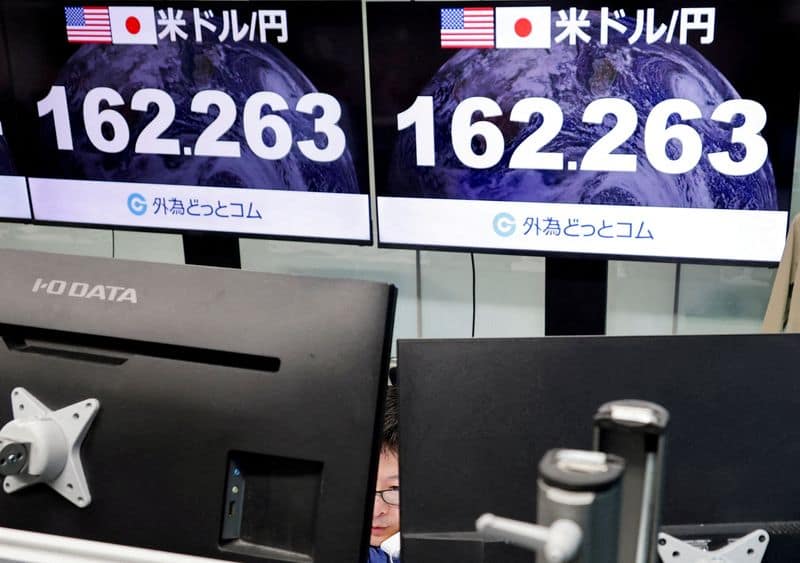
Japan and South Korea have engaged in a rare, coordinated market intervention to bolster their weakening currencies against the U.S. dollar. The yen experienced a notable surge, reaching the 157 range against the dollar, its strongest performance since 2022, sparking speculation of official intervention by Tokyo. Preliminary data suggests Japan may have sold as much as $58.97 billion in its efforts to support the yen, with some reports indicating a potential intervention size of $44 billion. The U.S. was also reportedly involved in rate checks.
Despite the intervention, the yen's gains proved temporary. As trading began in Japan, corporate customers bought dollars, causing the yen to reverse its surge and fall back into the 160 range against the dollar. This weakening occurred shortly after the Bank of Japan announced its decision to maintain its benchmark interest rate at 1%. The central bank also lowered its inflation forecast for the current fiscal year.
Bank of Japan Governor Kazuo Ueda commented on the economic outlook, signaling that the pace of rate hikes could accelerate if financial conditions are deemed too accommodative. He cited upside risks to inflation stemming from rising wages, prices, oil costs, and the weak yen. Meanwhile, Asian markets, led by South Korea's Kospi, saw a rally, with tech shares surging. Bitcoin traded near $63,900, largely unaffected by the Bank of Japan's policy decision.
Japan's special account for foreign exchange reserves recorded a surplus of $31 billion in fiscal year 2025, the second-highest on record. A weaker yen boosted yen returns on foreign assets, which helped offset interest costs on yen-denominated financing bills.