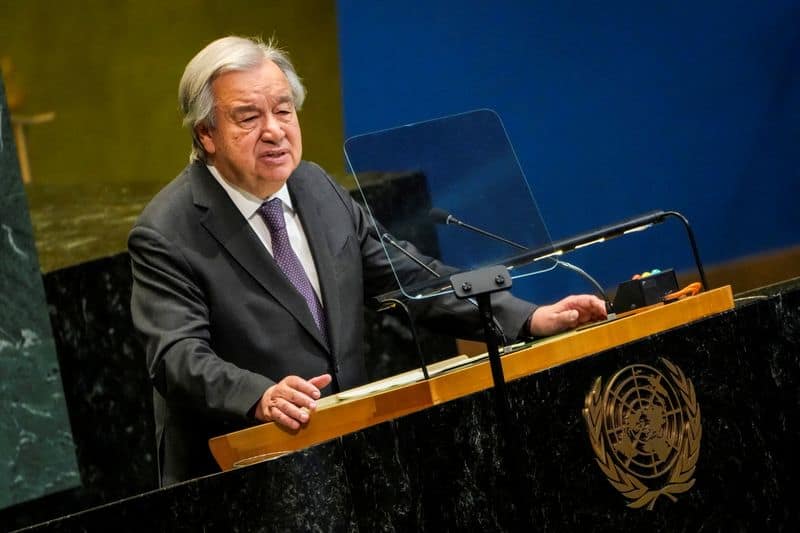
UN Chief Warns AI Development Outpaces Global Regulation
3 sources↑ Market-relevant3 events
IN SHORT
UN Secretary-General António Guterres warned that artificial intelligence is advancing at a pace that outstrips global regulatory efforts, urging international harmonization to mitigate risks, particularly to children. He highlighted AI's rapid impact on economies, work, elections, and security, and called for a ban on lethal autonomous weapons.
Key Numbers
193UN member states convened in Geneva
twoyears for AI to reach a billion people
2027year for next AI governance dialogue in New York
2030year for AI data centers to outpace all but five nations in electricity consumpt
Who's Involved
António Guterres
UN Secretary-General warning about AI development and governance
Andrej Karpathy
Coined the term 'vibe coding' used by Guterres
↳ Why This Matters
The rapid, unregulated advancement of artificial intelligence poses significant risks to global security, economic stability, and the integrity of information, necessitating urgent international cooperation and governance to ensure AI benefits humanity rather than harms it.
Key facts
UN Secretary-General António Guterres stated AI development is outpacing global regulation.
He called for international rules to manage AI's risks, particularly to children.
Guterres highlighted AI's rapid impact on economies, work, elections, and security.
He advocated for a ban on lethal autonomous weapons.
An AI Child Safety Pledge was launched.
The first Global Dialogue on AI Governance was held in Geneva.
United Nations Secretary-General António Guterres opened the first Global Dialogue on AI Governance in Geneva, warning that artificial intelligence is advancing at a pace that outstrips global regulatory efforts and institutions. He emphasized that AI's development is 'runaway' and faster than even its creators can fully comprehend, impacting economies, the future of work, elections, and global security.
Guterres used the term 'vibe coding'—a practice of letting AI write software with minimal human scrutiny—as a metaphor for dangerously passive governance, stating, 'We cannot vibe code the future of humanity.' He highlighted that current AI systems are increasingly making decisions with less human oversight, a capability for which existing institutions are unprepared.
Key proposals from Guterres included an international legal ban on lethal autonomous weapons, which he described as 'morally repugnant.' He also launched an AI Child Safety Pledge, requiring companies to prove AI safety before deployment to children and to ensure distressed children are connected to human support rather than chatbots. The dialogue, attended by all 193 UN member states, also addressed concerns about the concentration of AI power in a few companies and countries, and the erosion of the information ecosystem due to AI-enabled falsehoods.
A preliminary report from the Independent International Scientific Panel on Artificial Intelligence, comprising 40 scientists from 140 countries, was presented, finding that no one can currently guarantee AI will not cause catastrophic harm. The report also warned about the power dynamics and the threat to truth posed by AI. Guterres challenged major AI companies to run all data centers on renewable energy by 2030.
Frequently asked questions
'Vibe coding' is a term coined by Andrej Karpathy to describe programming by feel, where one tells AI what they want and lets it handle the rest without close scrutiny. UN Secretary-General António Guterres used it as a metaphor for passive AI governance.
The risks include the spread of misinformation, fueling polarization, enabling cyberattacks, weaponization, and the potential for AI to cause catastrophic harm. Specific concerns were raised about AI's impact on children and the development of lethal autonomous weapons.
Guterres called for an international ban on lethal autonomous weapons, launched an AI Child Safety Pledge, and challenged AI companies to power data centers with renewable energy by 2030. He also suggested creating a Global Fund for AI focused on computing access for developing countries.
What Happens Next
01A second Global Dialogue on AI Governance is scheduled for 2027 in New York.
02There is a call to conclude a legally binding instrument on lethal autonomous weapons systems.
✉Newsletter
Pick the topics you care about. Get only what matters, on your cadence.
How It Developed
UN Secretary-General António Guterres warned AI is developing faster than rules can keep up.
Guterres urged global harmonization of AI rules to reduce risks, especially to children.
He described AI deployment as faster than anyone can keep up with.
Guterres used the term 'vibe coding' as a metaphor for passive governance of AI.
He called for an international law ban on lethal autonomous weapons.
Guterres launched an AI Child Safety Pledge.
A second global dialogue on AI governance is scheduled for 2027 in New York.
Sources
T1
UN chief warns AI is developing faster than rules can keep upReuters