Key facts
- University of Delaware researchers are using sharks equipped with sensors to gather oceanographic data.
- The sensors measure conductivity (related to salinity), temperature, and depth.
- This data aims to improve predictions of hurricane intensity by assessing ocean heat content.
- Sharks are favored for this research due to their abundance and wide distribution.
- The project seeks to enhance coastal resilience by providing more reliable storm forecasts.
Scientists are exploring innovative methods to improve hurricane predictions, turning to sharks as mobile ocean-data observers. Researchers at the University of Delaware are attaching small electronic sensors, known as CTD tags, to sharks. These tags measure ocean conductivity, temperature, and depth, providing near real-time data on ocean conditions.
Aaron Carlisle, a professor at the university, explained that animal-borne sensors have been used for years, but sharks offer a new opportunity due to their abundance and wide distribution. The collected data is crucial for understanding the heat content of the ocean's mixed layer, which directly influences hurricane intensity. Warmer waters provide more energy for storms to strengthen.
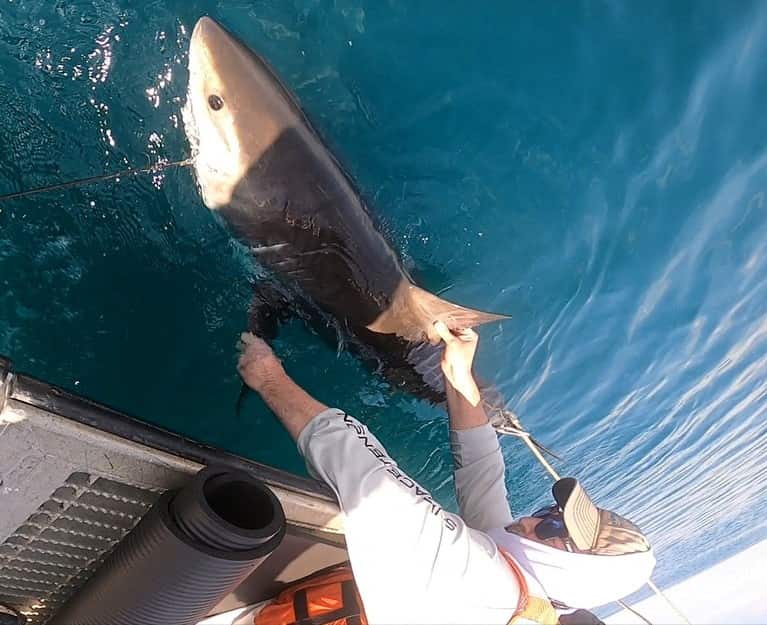
The tagging process, which begins in early May, involves researchers heading offshore to deploy baited lines. Once a shark takes the bait, the tags are attached to its dorsal fin. As the shark swims, the tags transmit data to orbiting satellites. The tagging procedure is designed to be quick, resembling a "pit crew" operation, and is conducted under strict animal care oversight to minimize stress and ensure data accuracy.
Caroline Wiernicki, a doctoral candidate, contrasted the scientific endeavor with popular, often dramatic, portrayals of sharks in films like "Jaws" and "Sharknado." She described the reality as more akin to an "accountant" clocking in data. If successful, this project could provide coastal communities with more reliable information to enhance their resilience against increasingly powerful storms.