Key facts
- The leaders said their P-8 and P-3C patrol aircraft are scheduled to fly in a maritime exercise in 2027, the first in a Quad context.
- The joint statement said the four strongly oppose unilateral actions that seek to change the status quo, including by force or coercion.
- The leaders expressed grave concerns about economic coercion, including through arbitrary export restrictions.
- The four unveiled the Indo-Pacific Maritime Surveillance Collaboration, aimed at improving information sharing and maritime domain awareness.
- The leaders announced plans to hold their inaugural business leaders' forum in early 2027.
- The leaders reaffirmed support for their artificial intelligence initiative and cited undersea cables and electricity infrastructure for regional connectivity.
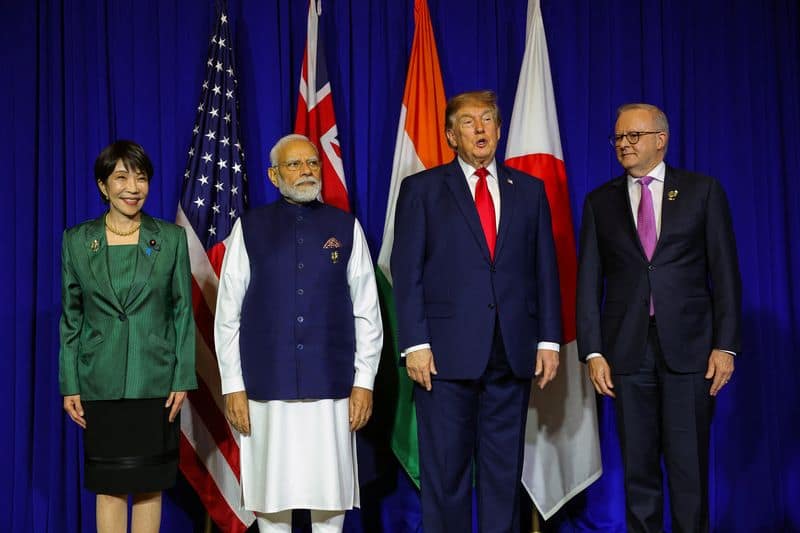
Leaders of the United States, Japan, Australia and India announced on November 17, 2026 that their maritime patrol aircraft are scheduled to take part in an exercise in 2027 for the first time under the Quad security grouping. The announcement came in a joint press release after US President Donald Trump, Japanese Prime Minister Sanae Takaichi, Australian Prime Minister Anthony Albanese and Indian Prime Minister Narendra Modi held a four-way summit in Manila on the sidelines of the ASEAN summit, Yonhap reported.
The four countries unveiled the Indo-Pacific Maritime Surveillance Collaboration, a new initiative aimed at improving information sharing and maritime domain awareness across the region. In the statement, the leaders said: "In 2027, our respective P-8 and P-3C patrol aircraft are scheduled to fly in a maritime exercise for the first time in a Quad context, making our seas safer."
The leaders also voiced strong opposition to unilateral attempts to change the regional status quo through force or coercion, and expressed concern over economic coercion, including arbitrary export restrictions. "We strongly oppose any destabilizing or unilateral actions that seek to change the status quo, including by force or coercion, which escalate tensions and undermine regional peace and stability," the statement said. "We express grave concerns about economic coercion, including through arbitrary export restrictions."