Key facts
- Mercedes-Benz said Drive Assist Pro will reach customers in the US and Germany, with wider rollout in the first half of 2027.
- The system combines 10 cameras, five radars and 12 ultrasonic sensors, coordinated by a domain controller using Nvidia's Orin processors.
- Mercedes-Benz said the setup delivers 254 tera operations per second, uses a 2.5 Gbit ethernet network and has more than 70GB of RAM.
- Driving decisions are made by Nvidia's Alpamayo end-to-end tokenized stack, with a rules-based system running alongside as a safety check.
- Ars Technica reported the system passed double-parked cars and stopped for stop signs, red lights and pedestrians during a San Francisco test drive.
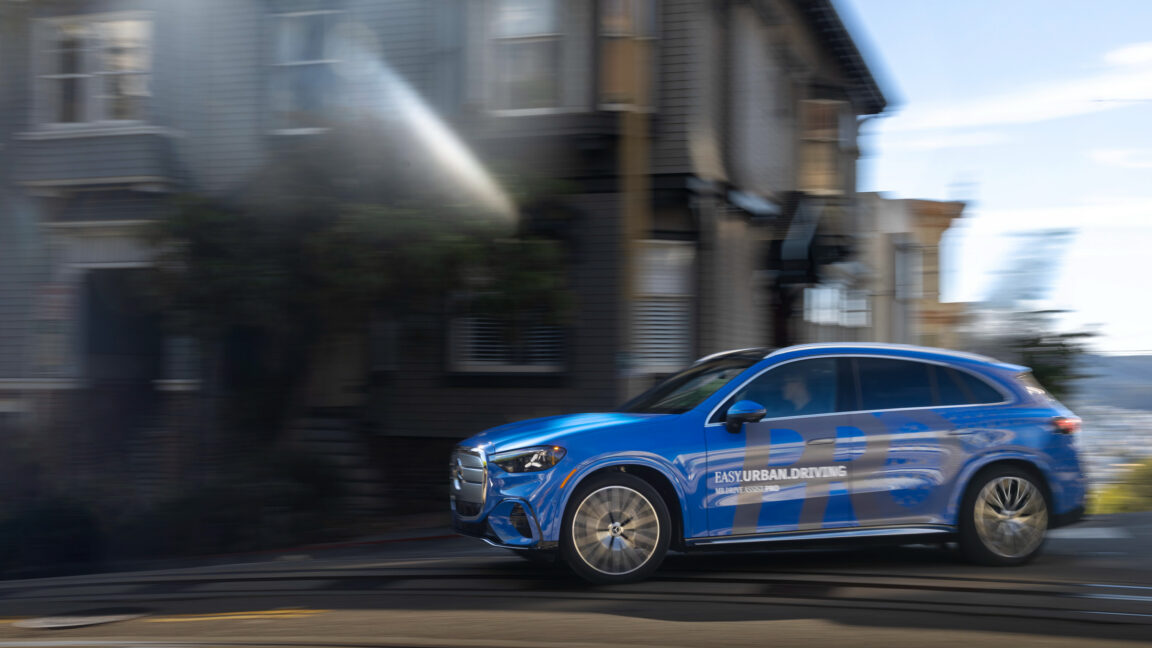
Mercedes-Benz is preparing to roll out Drive Assist Pro, a point-to-point partially assisted driving system, to customers in the US and Germany, Ars Technica reported on November 16, 2026, after a test drive in San Francisco. The system runs on the automaker's MB.OS operating system and is designed for lower-speed, complex traffic, which Mercedes-Benz describes as "level 2++" assistance.
Ars Technica reported that the system combines 10 cameras, five radars and 12 ultrasonic sensors, coordinated by a domain controller using Nvidia's Orin processors. Mercedes-Benz said the setup delivers 254 tera operations per second, uses a 2.5 Gbit ethernet network and has more than 70GB of RAM. Driving decisions are made by Nvidia's Alpamayo end-to-end tokenized stack, with a rules-based system running alongside as a safety check, according to the report.
Mercedes-Benz said some customers in Germany and California will join an early access program from December 2026, with a wider rollout in the first half of 2027 for model year 2026 CLAs and model year 2027 CLA, GLC Electric, GLE, GLS and S-Class vehicles. The report said the system is already live in China.
In the test drive, Ars Technica reported that the system passed double-parked cars, stopped for stop signs, red lights and pedestrians, and stayed engaged when the driver steered or accelerated, though any use of the brake turned it off. The report said the system's green arrowhead indicator was less prone to mode confusion than the hands-on-wheel icons used by some highway assists.