Key facts
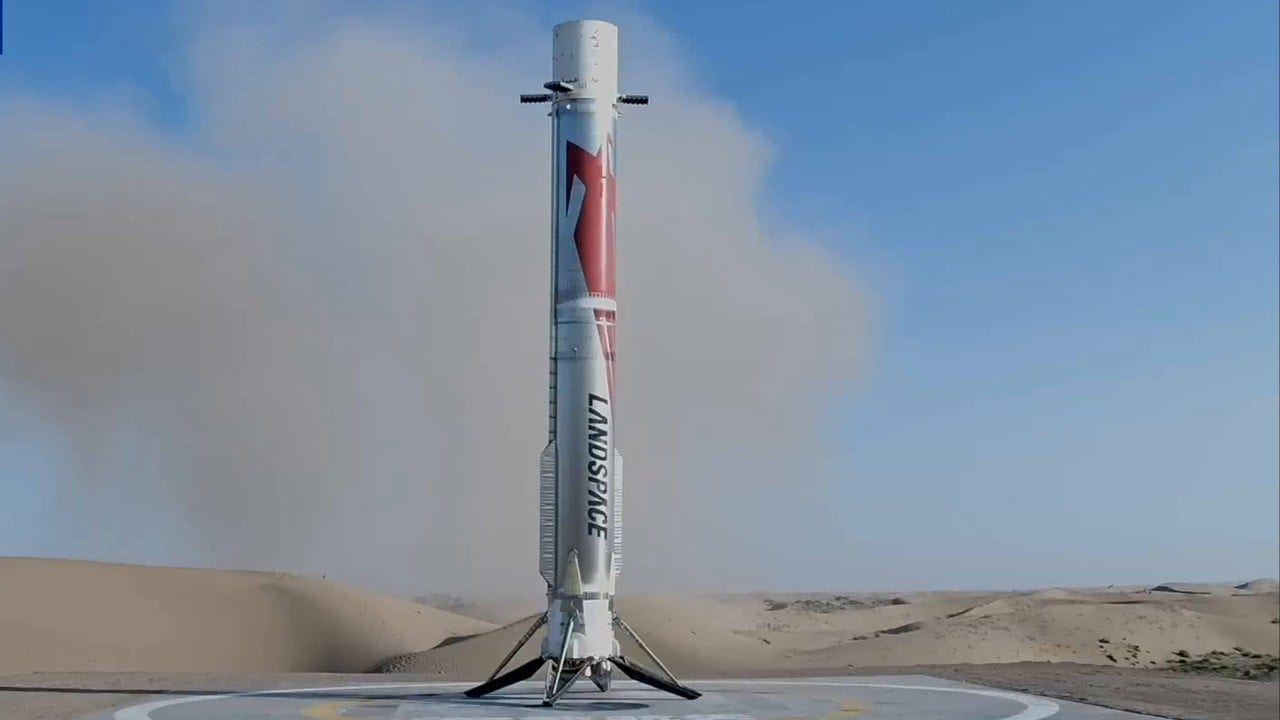
- LandSpace successfully recovered the first stage of its Zhuque-3 rocket on land.
- The recovery occurred in Gansu province after delivering a Honghu-3 internet satellite.
- This achievement places LandSpace alongside SpaceX and Blue Origin in reusable rocket technology.
- The Zhuque-3 rocket is constructed from stainless steel and uses methane and liquid oxygen fuel.
- LandSpace aims to reuse a recovered first stage within six months and fly each booster up to 20 times.
Chinese startup LandSpace has successfully recovered the first stage of its Zhuque-3 rocket on land, marking a significant step in China's pursuit of reusable rocket technology. The booster landed on its legs in Gansu province after launching a Honghu-3 internet satellite.
This achievement places LandSpace alongside U.S. companies like SpaceX and Blue Origin, narrowing China's gap in the field of reusable rockets. The ability to recover and reuse the most expensive part of a rocket is crucial for lowering launch costs and making spaceflight more commercially viable.
The Zhuque-3 rocket is built from stainless steel, offering potential cost and heat resistance advantages over SpaceX's Falcon 9, which uses an aluminum-lithium body. LandSpace's rocket is fueled by methane and liquid oxygen, a cleaner-burning mix than the kerosene used by the Falcon 9. The Zhuque-3 can carry 14.2 metric tons to low Earth orbit on a one-way flight.
While this marks China's first successful ground-based, leg-landed recovery of an orbital booster, LandSpace aims to reuse a recovered first stage within six months and fly each booster up to 20 times. SpaceX, however, remains significantly ahead, having reused Falcon 9 boosters dozens of times since 2017 and launching them around 150 times a year.
Eric Zhu, an analyst at Bloomberg Intelligence, called the recovery "a watershed moment for China's commercial space sector," but noted that LandSpace faces the challenge of demonstrating rapid and cost-effective refurbishment and reflying of its hardware.