Key facts
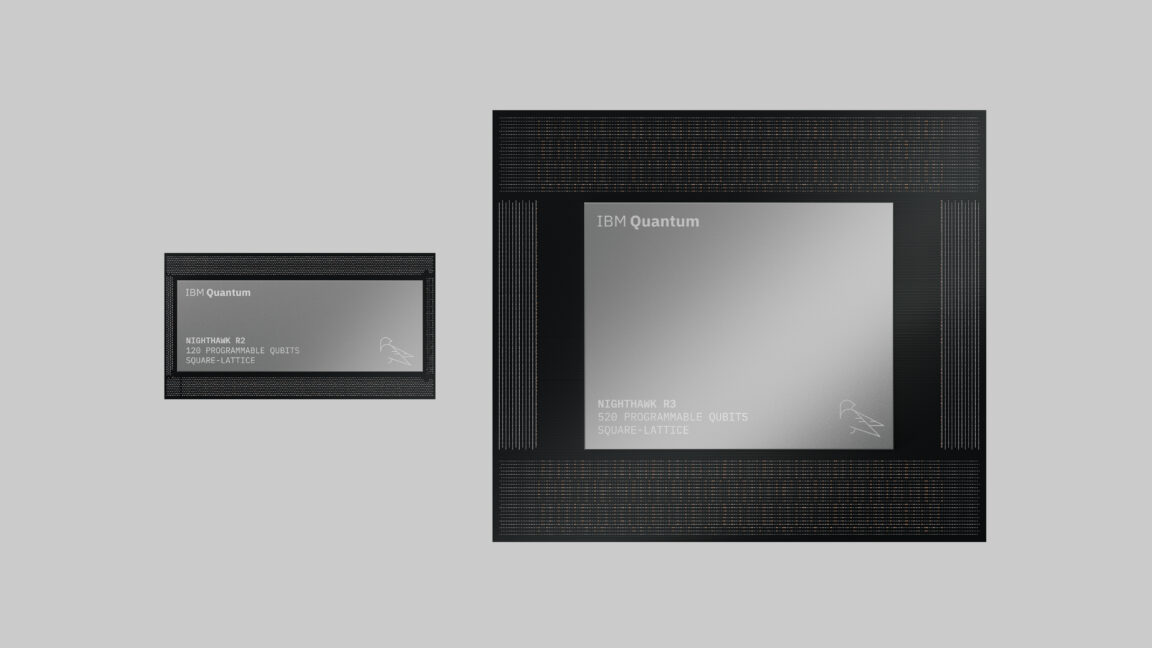
- IBM's 2027 Nighthawk r3 chip targets 520 programmable qubits, up from 120 in the r2 released in September 2026.
- IBM said the r2's hardware-based qubit resets accelerate some operations by up to 19-fold.
- IBM's Oliver Dial said four L-couplers joining two Nighthawk R1 processors reached state transfer fidelities of up to 99.4 percent.
- IBM's long-term plan pairs roughly 300 hardware qubits with a block of 12 logical, error-corrected qubits.
- IBM said it demonstrated a modular dilution refrigerator for cooling multiple chips and their connectors.
IBM used its Quantum Developer's Conference, held in the week of November 11, 2026, to update its roadmap toward error-corrected quantum computers before the end of the decade. The company said it now plans to offer a 1,040-qubit machine in 2027 by linking two Nighthawk chips, rather than the 1,080-qubit system built from nine chips its previous roadmap described. The total qubit count planned for 2027 is roughly unchanged.
The next chip, Nighthawk r3, targets 520 programmable qubits, up from 120 in the r2 released in September 2026. IBM said the r2 carries 458 physical qubits, most of them dedicated to resetting programmable qubits to the ground state, a change it says accelerates some operations by up to 19-fold.
Oliver Dial, an IBM vice president of Quantum Systems, said IBM had shown four L-couplers joining two Nighthawk R1 processors in the same refrigerator, reaching state transfer fidelities of up to 99.4 percent against a long-term target of 99.9 percent. Jerry Chow, IBM's CTO of Quantum-Centric Supercomputing, said the speed of those connections is comparable to qubit interconnections on the chip itself. Dial said IBM is still working out how many couplers would be needed to link chips hosting error-corrected qubits.
IBM's long-term plan pairs roughly 300 hardware qubits with a block of 12 logical, error-corrected qubits. Reaching more than 100 logical qubits would require both a larger chip and five or more linked chips, which IBM would need to complete by the end of 2027 to stay on its revised schedule.