All NewsEducationTV
Equities & FundsCrypto & Digital AssetsAI & TechnologyBusiness & CorporateUS Politics & PolicyGeopolitics & Global RiskMacro, Rates & FXCommodities & EnergyEuropean Politics & MarketsAsia-PacificReal Estate & Property
All NewsHome
← Back to AI & Technology

Humanoid robots break records, crash and burn at World Robot Games

Created at 25 Aug · 9:05 PM1 source↑ Market-relevant
IN SHORT

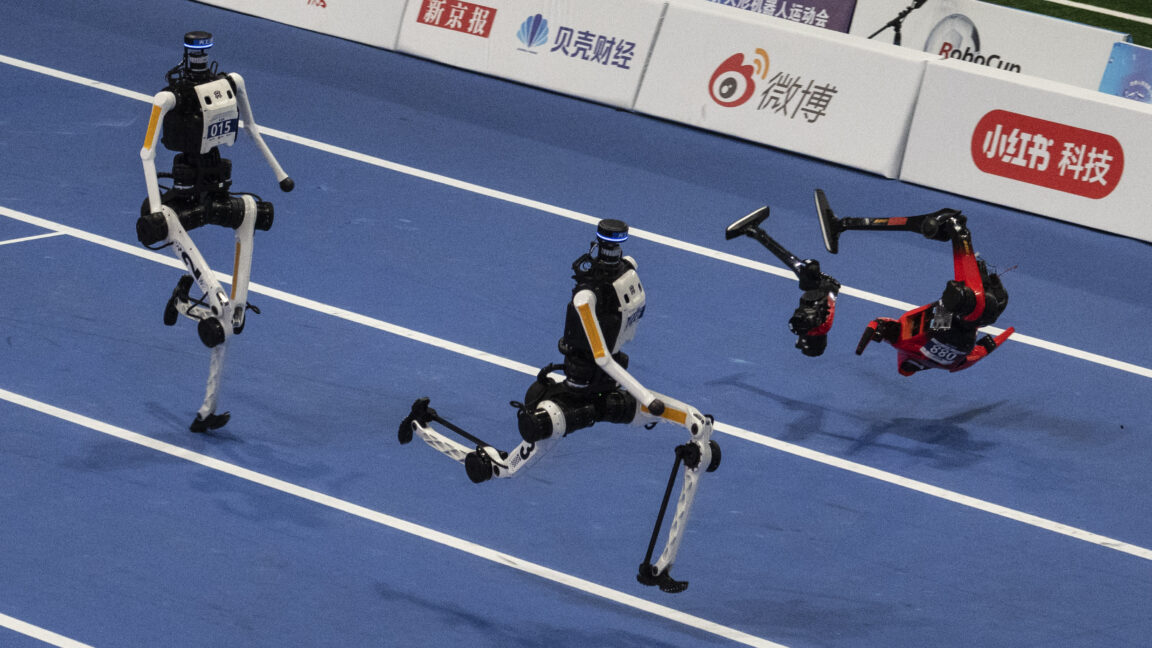
Humanoid robots at the World Robot Games in Beijing shattered human speed records but also crashed, caught fire, and broke apart, highlighting both advancements and limitations in robotic control and autonomy.

Key Numbers

100-metersprint record broken by robots
2ndedition of World Robot Games
August 22–26, 2026dates of the games
30 minutestime limit for firefighting challenge
3robot teams completed firefighting challenge
12robot teams competed in firefighting challenge

Who's Involved

Dipam Patel
PhD candidate in computer science at Purdue University and research assistant at US Army DevCom Army Research Lab
X-Humanoid
Beijing-based company whose robot gained viral fame
Global Times
Chinese state media publication reporting on the games
Humanoid robots break records, crash and burn at World Robot Games

↳ Why This Matters

The World Robot Games highlight the dual nature of current humanoid robot development: impressive leaps in specific task performance alongside significant limitations in autonomy, safety, and generalizability, signaling both future potential and current challenges for the industry.

Key facts

  • Humanoid robots at the World Robot Games in Beijing surpassed human records in speed events.
  • Several robots experienced failures, including crashing, breaking apart, and catching fire.
  • The games included both high-speed races and practical tasks like household chores.
  • Many participating robots were still teleoperated by human controllers.
  • The event aimed to showcase the commercial potential of humanoid robots.

The 2nd World Humanoid Robot Games, held in Beijing from August 22-26, 2026, showcased significant advancements in robotic capabilities, with some robots breaking human world records in speed events like the 100-meter sprint and standing high jump. However, the games also highlighted the limitations of current humanoid robot technology, as many machines crashed into barriers, fell, or even broke apart and caught fire.

Experts noted that while these achievements demonstrate progress in whole-body control for specific tasks, the robots are far from general-purpose autonomous systems. Many were engineered for single tasks, evidenced by running robots unable to stop or slow down after crossing the finish line. The event included a variety of competitions, from martial arts and sports to more mundane household chores like washing laundry and folding clothes, and practical scenarios such as hotel services and firefighting.

The inclusion of less flashy, more practical tasks suggests organizers aimed to highlight the commercial potential of humanoid robots amid rapid development in China's robotics industry. However, the prevalence of human teleoperation in many events underscored the ongoing challenges in achieving true robot autonomy. While some robots were penalized for being remotely controlled, the continued reliance on human operators indicates that robots still require extensive training and struggle with generalizing tasks across different environments and edge cases.

Frequently asked questions

Humanoid robots broke human world records in the 100-meter sprint and standing high jump, demonstrating significant progress in whole-body control for specific tasks.

Many robots crashed, fell, broke apart, or caught fire, indicating issues with stopping, slowing down, and overall robustness. Teleoperation was still common, showing a lack of full autonomy.

The games included practical scenarios like washing laundry, folding clothes, cleaning, handling deliveries, hotel services, firefighting, and dexterity tasks like hammering nails.

These tasks are seen as benchmarks for commercial potential and demonstrate the ongoing efforts to develop robots capable of performing everyday chores and services.

What Happens Next

01Future robot games may require robots to demonstrate reliability over multiple trials.
02Further development is needed for robots to safely slow down and stop.
03Algorithmic development must advance for robots to generalize tasks in varied environments.

How It Developed

Humanoid robots competed in the 2nd World Robot Games in Beijing.
Robots broke human records in 100-meter sprint and standing high jump.
Some robots crashed into barriers, fell, or broke apart.
A few robots caught fire during the competitions.
New practical tasks like laundry and delivery handling were introduced.
Many robots were still teleoperated by humans, with penalties for remote control.
The event showcased the rapid development of China's robotics industry.

Sources

T1
World humanoid robot games show runners breaking records, bursting into flamesvar abtest_2169056 = new ABTest(2169056, 'impression');Ars Technica

Related Stories

Chinese humanoid robot sets 100m sprint record at Beijing Games
25 Aug · 4:36 PM
China's quiet machine revolution: AI and robotics in factories and classrooms
24 Aug · 10:26 PM
New bootloader grants full control over Meta Quest headsets
25 Aug · 4:11 PM
US robot curbs highlight reliance on Chinese parts
25 Aug · 1:07 PM
Apple unveils Mac Studio, Mac mini with M5 Ultra and M6 chips for AI
25 Aug · 1:12 PM