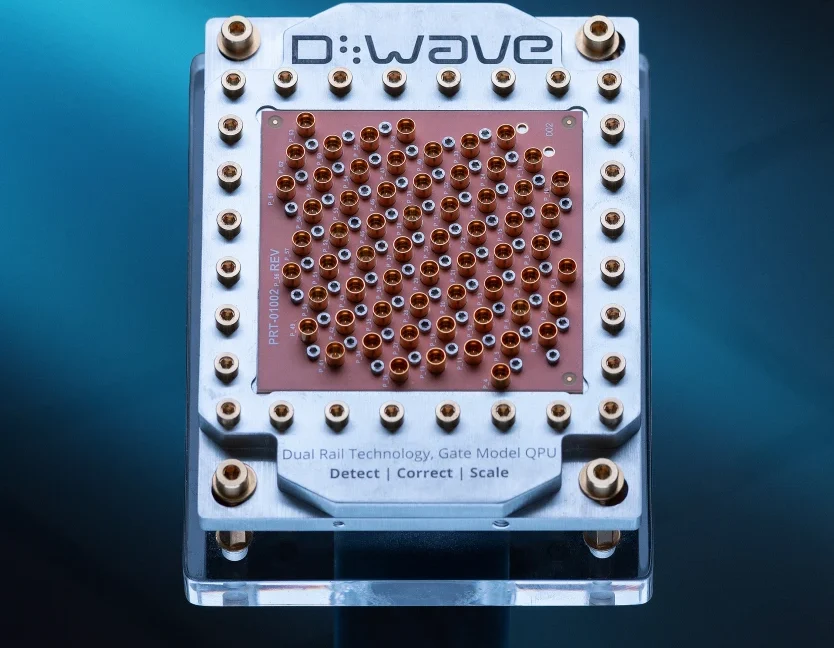
Key facts
- D-Wave has demonstrated entanglement of two dual-rail qubits.
- The dual-rail qubit technology simplifies error detection by making photon loss the most common error.
- This error hierarchy is preserved during entangling operations, according to new research.
- The company aims to use this technology to build more efficient quantum computers.
- D-Wave plans to have 181 dual-rail qubits by 2028.
D-Wave, known for its quantum annealers, is advancing its work on gate-based quantum hardware by validating its dual-rail qubit technology. The company has published research in Nature demonstrating that two of these qubits can be entangled while maintaining their advantageous error detection properties. Dual-rail qubits, which utilize linked resonators, are designed such that the most common error is photon loss, easily detectable as an erasure. This simplified error hierarchy, with phase flips as the next most common error and bit flips being rare, is expected to streamline error correction, potentially reducing the hardware overhead for creating logical qubits.
The research shows that entangling two dual-rail qubits can be achieved rapidly, within approximately 500 nanoseconds, and crucially, preserves the error hierarchy observed in single-qubit operations. Photon loss remained the dominant error, occurring at a rate of about 0.5 percent per entanglement, while bit-flip errors were found to be nearly non-existent. D-Wave plans to scale this technology, aiming for 181 dual-rail qubits by 2028, which could enable more efficient pathways to useful quantum computation.