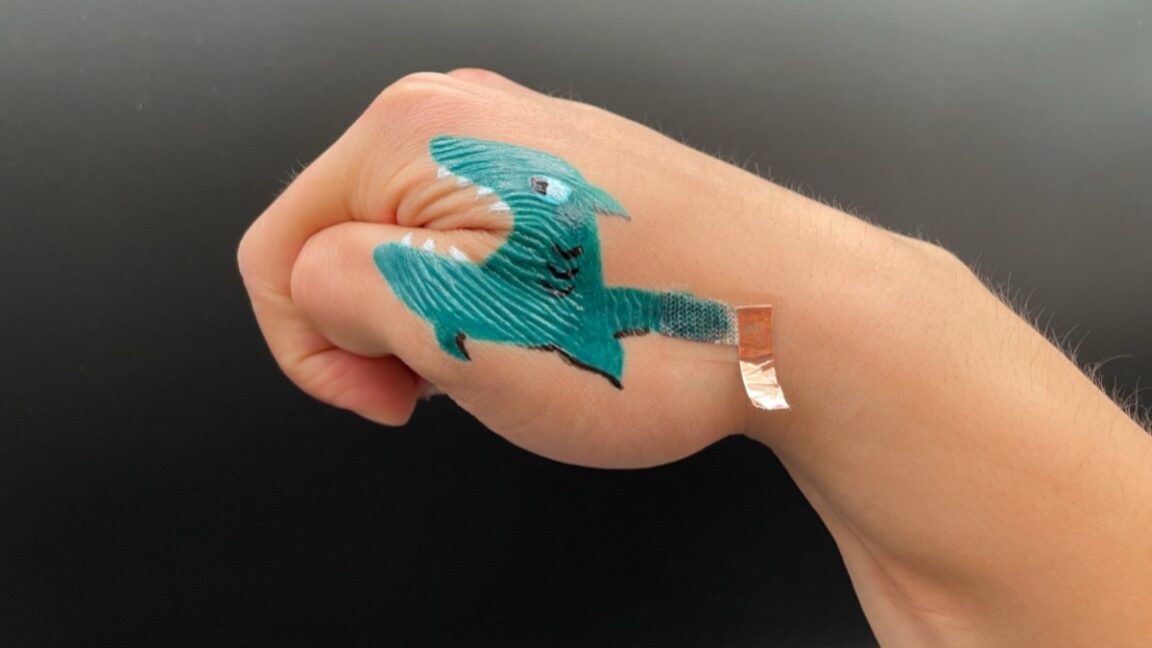
Key facts
- Penn State University scientists created a new conductive ink for e-tattoos.
- The ink can be applied to the skin in colorful, custom designs.
- Once dry, the ink acts as a functional electrode for biomonitoring.
- This technology aims to improve upon existing e-tattoo limitations, such as poor performance on curved or hairy skin.
- The ink is composed of polymers and acidic additives in a water-based ethanol/polyvinyl alcohol solution, including PEDOT:PSS for conductivity and DBSA for flexibility.
Scientists at Penn State University have developed a novel conductive ink that can be painted directly onto the skin in colorful custom designs, transforming into a functional electrode for biomonitoring after drying. This innovation, detailed in a paper published in the Proceedings of the National Academy of Sciences (PNAS), seeks to address limitations of existing epidermal electronics, or e-tattoos, which have been in development for over a decade.
Previous e-tattoos, often attached via temporary tattoo-like polymers, have struggled with functionality on curved or hairy surfaces and require careful placement for accurate readings of spatially distributed biosignals. Researchers have explored solutions, such as polymer-based conductive inks for scalp monitoring of brain waves. Penn State's approach, led by mechanical engineer Larry Cheng, aims to create a more versatile and accurate biosensing solution.
Cheng, with over 10 years of experience in electrode design for applications like EEGs, ECGs, and EMGs, noted the instability of rigid materials like metals when the wearer moves. While hydrogels offer flexibility, they degrade quickly. The new conductive ink is a water-based ethanol/polyvinyl alcohol solution containing various polymers and acidic additives. Key components include PEDOT:PSS for electrical conductivity and DBSA, which acts as a plasticizer to enhance the ink's flexibility.