Key facts
- Chinese embodied AI funding reached 93.5 billion yuan in the first half of 2026, five times the year-earlier total, per ITjuzi.
- X Square, Galaxea and Spirit AI each reached valuations of roughly $3 billion, according to company disclosures.
- Hong Kong-listed UBTech advertised a chief scientist role paying up to 124 million yuan ($18 million) including equity and benefits.
- Unitree has about 30 researchers working on AI that predicts how objects behave, per a person briefed by the company.
- DexForce said it can prepare some industrial tasks for deployment within 6 to 8 hours, with success rates above 99.9% in specified precision operations.
- Chinese firms face shortages of advanced Nvidia chips due to US export controls, and a squeeze on IPO funding amid regulatory concerns over valuations.
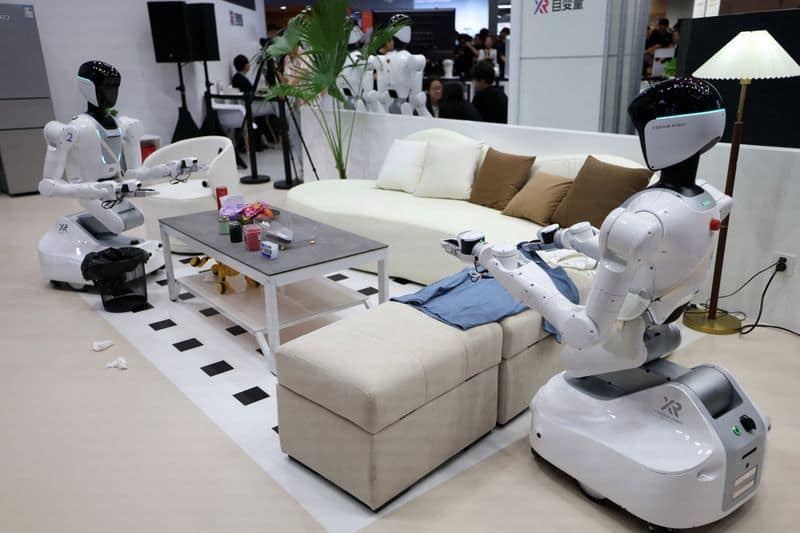
Chinese robotics companies are directing money toward the software that lets humanoid machines understand surroundings and learn unfamiliar tasks, a field the industry calls embodied AI. Chinese embodied AI companies raised 93.5 billion yuan ($13 billion) across 322 deals in the first half of 2026, five times the amount a year earlier, according to data research firm ITjuzi.
Dermot McGrath, founder of Shanghai-based technology consultancy ZenGen Labs, said robot makers have concluded that the margin will not come from hardware but from the brain. Spirit AI co-founder Gao Yang said the brain is the weakest link in the complete robotics stack.
American startups including Physical Intelligence, Skild AI and Generalist are developing software meant to teach robots skills without extensive retraining. Generalist says its GEN-1.5 model completed around 60% of simple tasks after viewing a demonstration lasting between 3 and 12 seconds. X Square has published research showing robots acquiring handling skills from a single human video.
Specialist Chinese startups X Square, Galaxea and Spirit AI have each reached valuations of roughly $3 billion, according to company disclosures. Hong Kong-listed UBTech advertised a chief scientist position overseeing AI model development with compensation of up to 124 million yuan ($18 million), including equity and benefits. Hangzhou-based Unitree has about 30 researchers developing AI that predicts how objects behave, according to a person briefed by the company.
Training data is gathered in different ways. Spirit AI has hired around 1,000 people to record everyday and industrial activities, Gao said. ACE Robotics uses wearable sensors to capture workers' movements and grip forces in stores and hotels. Robbyant said it trained a model using 160,000 hours of material, including 50,000 hours of human-guided robot movements, and trained software on 20 robot configurations from 17 brands. DexForce uses computer-generated environments and said it can prepare some industrial tasks for deployment within 6 to 8 hours, reporting success rates above 99.9% in specified precision operations.