Key facts
- Broadcom will lend Anthropic up to $42 billion to lease chips.
- Anthropic is expected to become Broadcom's largest compute customer in 2027.
- The financing arrangement could convert into Anthropic shares.
- Broadcom's dual role as hardware supplier and financing partner presents potential conflicts of interest.
- Anthropic's IPO prospectus details AI's potential and existential risks.
- Anthropic warned that runaway AI could end humanity within a decade.
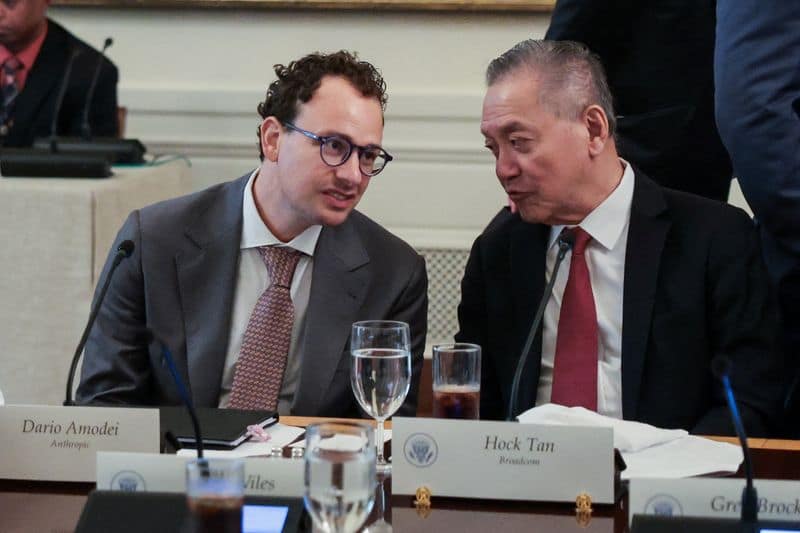
Chipmaker Broadcom has agreed to lend AI firm Anthropic up to $42 billion to finance infrastructure spending, a complex relationship detailed in Anthropic's initial public offering prospectus. This arrangement positions Anthropic to become Broadcom's largest customer for its chip design business by 2027, highlighting the significant reciprocal spending that has fueled investor interest in the artificial intelligence sector.
The financing deal, which could allow for debt instruments to be converted into Anthropic shares, is part of a larger $125.2 billion commitment Anthropic has made for a five-year lease of tensor processing unit (TPU) computing capacity. Google, a collaborator on TPUs, has also expanded its partnership with Anthropic and Broadcom for next-generation compute capacity starting in 2027.
This financing strategy mirrors that of rival Nvidia, which has leveraged its financial strength to boost chip sales. However, Anthropic's filing also disclosed that Broadcom's dual role as a hardware supplier and financing partner presents "potential conflicts of interest." These conflicts could impact Anthropic's access to necessary computing power and its ability to procure infrastructure, as Broadcom's pricing and hardware decisions could affect Anthropic's procurement capabilities.
Concerns about the risks posed by AI now threaten to dim that optimism after current and former Anthropic staff came out with public warnings that runaway AI could end humanity within a decade. Amodei told the UN Security Council last week that AI could threaten humankind and was “the most important global security issue facing the world today.” The Anthropic chief has this month led public calls for “pacing the frontier” of AI development. His arch-rival at OpenAI, Sam Altman, along with Musk, backed Amodei’s proposals for industry co-operation to slow development and enhance safety measures, in a rare moment of unity. Safety concerns have increased following a series of high-profile cyber security incidents in which AI “agents” have breached external systems. Last week, OpenAI revealed its tools had hacked “dozens” of external sites, including governments. The ChatGPT maker on Monday scrapped plans to release its newest model next month, citing safety concerns.