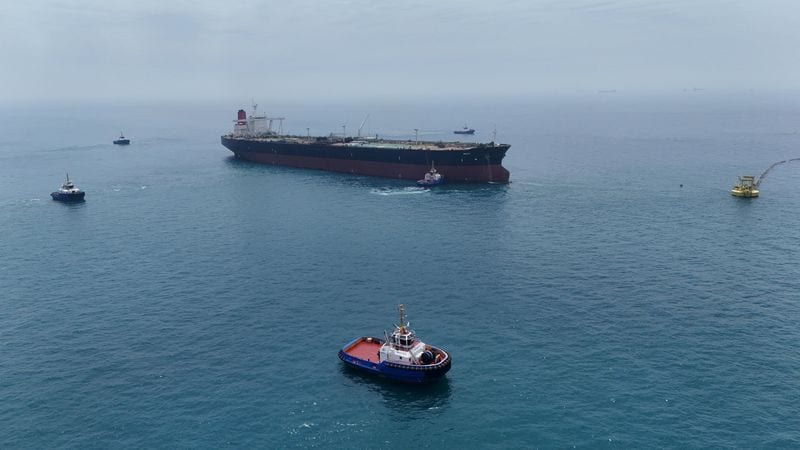
Oil Prices Extend Decline on Expectations of Smoother Crude Flows via Hormuz
window 24h
IN SHORT
Oil prices are declining, nearing four-month lows, as tanker traffic through the Strait of Hormuz is expected to increase. This follows claims by President Donald Trump of a "secret mission" to escort tankers and a US-Iran sanctions waiver. Tanker rates have nearly doubled in a week, with some VLCCs earning up to $470,000 daily. Meanwhile, Middle East EDC output remains low due to vessel congestion and weak prices, though Saudi Arabian phosphate cargoes have begun transiting Hormuz again after a de-escalation of tensions.
✉Newsletter
PiQ Daily
Pick your topics. Get only what matters, on your cadence.
Key Numbers
1%oil price decline on Wednesday
four-monthlows for oil prices
$470,000daily rate for some VLCCs
154,000ttotal tonnage of Saudi DAP/MAP cargoes
Who's Involved
Donald Trump
U.S. President announcing a secret mission to escort tankers
Saudi Arabia
nation whose phosphate cargoes are transiting Hormuz
Iran
nation involved in US sanctions and de-escalation of hostilities
US
nation involved in Iran sanctions and de-escalation of hostilities
VLCCs
tankers commanding high daily rates
Fujairah
location anticipating the return of Iranian HSFO
1 / 2
Key facts
Oil prices fell more than 1% on Wednesday.
Tanker rates have nearly doubled in a week.
Some VLCCs are commanding up to $470,000 daily.
President Donald Trump claimed a "secret mission" to escort tankers.
Middle East EDC production remains low.
Three Saudi Arabian DAP/MAP cargoes totaling 154,000t have transited the Strait of Hormuz.
This is the first phosphate cargo transit since early May.
A US-Iran sanctions waiver is pressuring oil prices.
Eased hostilities in Lebanon are pressuring oil prices.
Oil prices have fallen over 1% on Wednesday, approaching four-month lows, driven by expectations of smoother crude flows through the Strait of Hormuz. This anticipated increase in tanker traffic is attributed to a US-Iran sanctions waiver and eased hostilities in Lebanon. Concurrently, tanker rates have surged, nearly doubling in the past week, with some Very Large Crude Carriers (VLCCs) commanding daily rates as high as $470,000. This surge follows President Donald Trump's announcement of a "secret mission" aimed at escorting tankers at night with their transmitters turned off.
Despite the de-escalation of tensions and the resumption of shipments through the Strait of Hormuz, Middle East EDC (Ethylene Dichloride) production remains subdued. This is attributed to ongoing vessel congestion, high inventory levels, and weak prices for VCM (Vinyl Chloride Monomer) and PVC (Polyvinyl Chloride). While Fujairah anticipates the return of Iranian HSFO (High Sulphur Fuel Oil), market participants express caution regarding the timeline and the enforcement of any agreements.
In a concrete sign of the easing situation, three Saudi Arabian DAP/MAP (Diammonium Phosphate/Monoammonium Phosphate) cargoes, totaling 154,000 tons, have successfully transited the Strait of Hormuz since the beginning of the week. This marks the first instance of phosphate cargoes crossing the strait since early May, following a period of heightened tensions between the US and Iran. The increased tanker traffic and the resumption of cargo movements through this critical chokepoint are contributing to the downward pressure on oil prices.
↳ Why This Matters
Oil prices have fallen over 1% on Wednesday, approaching four-month lows, driven by expectations of smoother crude flows through the Strait of Hormuz. This anticipated increase in tanker traffic is attributed to a US-Iran sanctions waiver and eased hostilities in Lebanon. Concurrently, tanker rates have surged, nearly doubling in the past week, with some Very Large Crude Carriers (VLCCs) commanding daily rates as high as $470,000. This surge follows President Donald Trump's announcement of a "secret mission" aimed at escorting tankers at night with their transmitters turned off.
Frequently asked questions
The Strait of Hormuz is a vital maritime chokepoint connecting the Persian Gulf and the Gulf of Oman. A significant portion of the world's oil supply passes through it.
Oil prices are falling due to signs of increased tanker traffic through the Strait of Hormuz, a US-Iran sanctions waiver allowing Tehran to sell oil, and easing hostilities in Lebanon.
The US-Iran deal involves a 60-day sanctions waiver for Iran and discussions on navigation administration in the Strait of Hormuz, aiming to ease tensions and restore oil shipments.
Dark mode refers to tankers switching off their Automatic Identification System (AIS) transponders and other tracking signals, making them difficult to monitor, often used to protect cargoes during periods of heightened risk.
What Happens Next
01Further progress in nuclear negotiations could push prices back to pre-war levels.
02Investors are watching for restoration of exports by Middle Eastern producers.
03Investors are watching for more ships to enter the region.
Get the newsletter.
Pick the topics you actually care about. We'll email when there's news worth your time, on the cadence you choose. Cancel any time from your account.