Key facts
- Ireland's beef production fell 14% year-on-year in early 2026.
- EU and UK beef markets saw production fall 4% year-on-year by February 2026.
- Beef imports into the EU surged 33% year-on-year in January 2026.
- EU beef exports fell 13% year-on-year in January 2026.
- The EU-Mercosur agreement provisionally took effect on May 1, allowing Mercosur countries to export beef to the EU under new quotas.
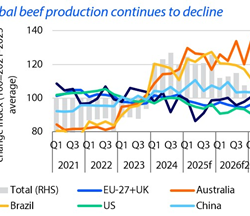
Ireland experienced the most significant decline in beef production within the EU at the start of 2026, with a 14% year-on-year drop, according to RaboResearch's Global Beef Quarterly report. Across the EU and UK, beef markets faced tighter supplies as production fell by 4% year-on-year by February. Other major EU producers also saw declines, including France (2%), Germany (4%), and Poland (8%). Globally, beef production decreased by 2.5% in the first quarter of 2026, with contractions noted in Brazil, the United States, and China. Concurrently, the EU saw a 33% surge in beef imports in January 2026, while exports decreased by 13%. Major contributors to the import increase included Brazil (up 57%), Uruguay (up 55%), New Zealand (up 195%), and Australia (up 61%). The provisional effect of the EU-Mercosur agreement on May 1 allows Mercosur countries to export beef to the EU under the Hilton Quota and a new, gradually increasing quota at a 7.5% tariff. Analysts suggest that while these trade agreements will improve Mercosur beef's competitiveness in the EU, their short-term impact on volumes may be limited due to existing high export levels. Similarly, the Australia-EU agreement, with its phased-in quota over 10 years, will see benefits materialise over time.