Key facts
- Comet 3I/ATLAS is estimated to be between 10 and 12 billion years old.
- Its chemical composition differs significantly from objects within our solar system.
- The comet likely formed in a colder, more irradiated environment than our solar system.
- Observations using the James Webb Space Telescope provided data on isotope ratios.
- 3I/ATLAS contains abundant organic molecules, including elements essential for life.
- It is the third interstellar object detected in our solar system.
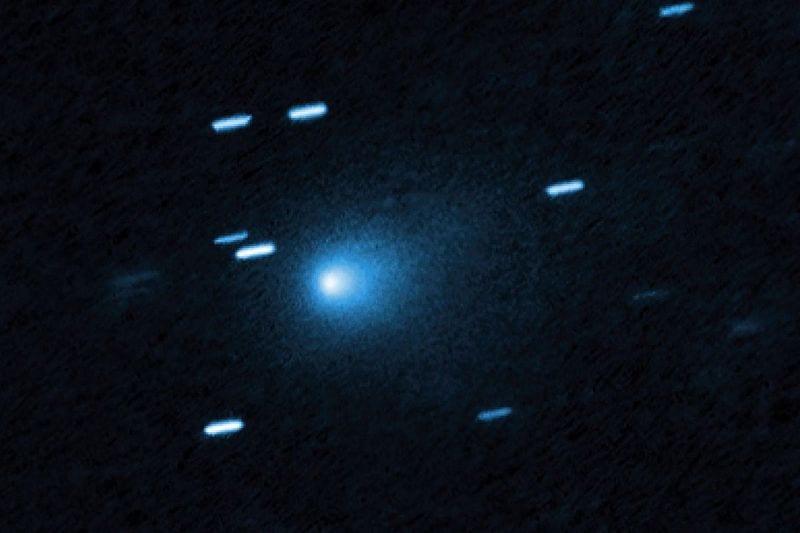
Scientists studying the interstellar comet 3I/ATLAS have determined it is an ancient object, likely formed 10 to 12 billion years ago in a planetary system distinct from our own. This ancient visitor, only the third interstellar object ever detected in our solar system, has a chemical composition that provides insights into the conditions of its home planetary system.
The comet, approximately 1.6 miles (2.6 km) in diameter, is considered the oldest known object to have passed through our solar system. Researchers suggest it originated in a much colder environment, around minus-405 degrees Fahrenheit (minus-243 degrees Celsius), compared to the formation conditions of Earth and other solar system bodies about 4.5 billion years ago.
Using the James Webb Space Telescope, scientists analyzed the comet's isotope ratios, particularly of hydrogen and carbon. The hydrogen isotopes offered clues about the temperature and radiation levels of its formation environment, while carbon isotope ratios shed light on the composition of the interstellar gas cloud that birthed the comet and its home planetary system. Notably, 3I/ATLAS's water contains about 30 times more deuterium than comets found in our solar system, and its carbon isotope ratios differ from those observed in local solar system objects and nearby star-forming disks.
Lead author Martin Cordiner stated that the planet-forming environment of 3I/ATLAS's host system was distinct from ours, being colder, less metal-rich, and more heavily irradiated by UV and cosmic rays. Despite its harsh origin, the comet is rich in organic molecules containing carbon, hydrogen, nitrogen, oxygen, and sulfur, indicating that the essential elements for life were abundant in its distant formation disk.
The carbon composition suggests 3I/ATLAS formed around 12 billion years ago, during a period of intense star formation in the universe, which began approximately 13.8 billion years ago. While researchers believe it originated in the Milky Way, its age means an origin in another galaxy cannot be ruled out.
Scientists theorize that 3I/ATLAS was ejected from its home system due to gravitational interactions with planets or possibly a collision. The comet is currently approaching Saturn's orbit and is expected to leave the solar system's outer boundary around 2035. Researchers have dismissed speculation that the object could be an alien spacecraft, stating that evidence strongly indicates it is a natural, comet-like object.