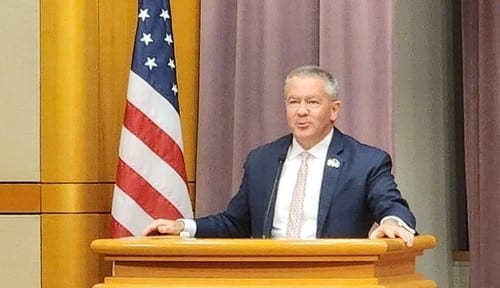
US focused on meeting conditions for wartime operational control transfer to South Korea
window 24h
IN SHORT
South Korea is navigating complex domestic and international challenges. The government plans to abolish the prosecution's investigative rights, a move aimed at separating investigation and indictment, though facing opposition concerns. Meanwhile, a Prime Minister nominee described North Korea as both a threat and a compatriot, stressing the need for peace management. Internationally, the U.S. is focused on meeting conditions for transferring wartime operational control to South Korea and has praised Seoul's semiconductor prowess crucial for AI supply chain security. Separately, investigators are probing election officials over ballot shortages during local elections.
✉Newsletter
PiQ Daily
Pick your topics. Get only what matters, on your cadence.
Who's Involved
United States
prioritizing conditions for wartime operational control transfer to South Korea
South Korea
recipient of potential wartime operational control transfer and praised for semiconductor prowess
Kim Min-seok
Prime Minister announcing the abolition of prosecution's investigative rights
Han Seong-sook
Prime Minister nominee discussing North Korea relations
North Korea
described as a threat and a compatriot by a Prime Minister nominee
National Election Commission
under investigation for ballot shortages during local elections
1 / 5
Key facts
The U.S. is prioritizing conditions for transferring wartime operational control to South Korea.
A senior U.S. diplomat stated the U.S. aims to meet OPCON transfer conditions as soon as possible.
A senior U.S. official praised South Korea's semiconductor production and expertise.
South Korea's role in semiconductors is seen as important for securing AI supply chains.
The Pax Silica summit was held in Washington.
Investigators questioned two election officials regarding ballot shortages.
The probe concerns allegations against the National Election Commission for reducing ballot numbers and failing to respond to shortages.
South Korea's government decided to abolish the prosecution's investigative rights.
Prime Minister Kim Min-seok announced the abolition of the prosecution's investigative rights.
The move aims to separate investigation and indictment.
Prime Minister nominee Han Seong-sook described North Korea as both a threat and a compatriot.
Han Seong-sook emphasized managing relations for peace on the Korean Peninsula.
South Korea's government is set to abolish the prosecution's investigative rights, a significant reform announced by Prime Minister Kim Min-seok. This decision aligns with the administration's objective to separate the functions of investigation and indictment, a move that has drawn concerns from the opposition party. In parallel, Prime Minister nominee Han Seong-sook addressed the complex relationship with North Korea during her confirmation hearing, characterizing the nation as both a "threat" and a "compatriot." She emphasized the critical importance of managing inter-Korean relations to ensure peace on the Korean Peninsula.
On the international front, the United States is prioritizing the conditions required for the transfer of wartime operational control (OPCON) to South Korea. A senior U.S. diplomat indicated that the U.S. aims to meet these conditions as soon as possible, acknowledging differing timelines between Seoul and Washington on the matter. Furthermore, a senior U.S. official lauded South Korea's substantial contributions to semiconductor production and its expertise, particularly in the context of a U.S.-led initiative to secure artificial intelligence supply chains. These remarks were made at the Pax Silica summit held in Washington.
Domestically, a separate investigation is underway concerning ballot shortages during the June 3 local elections. Investigators questioned two election officials on Thursday regarding allegations that the National Election Commission reduced ballot numbers and failed to adequately address shortages on election day. This probe adds another layer of scrutiny to the country's electoral processes.
↳ Why This Matters
South Korea's government is set to abolish the prosecution's investigative rights, a significant reform announced by Prime Minister Kim Min-seok. This decision aligns with the administration's objective to separate the functions of investigation and indictment, a move that has drawn concerns from the opposition party. In parallel, Prime Minister nominee Han Seong-sook addressed the complex relationship with North Korea during her confirmation hearing, characterizing the nation as both a "threat" and a "compatriot." She emphasized the critical importance of managing inter-Korean relations to ensure peace on the Korean Peninsula.
Frequently asked questions
Wartime operational control refers to the authority to command military forces during a conflict. South Korea seeks to regain this control from the United States.
South Korea aims to enhance its military autonomy and readiness to defend itself, particularly in the face of regional security challenges.
Conditions include South Korea's ability to lead combined forces, its strike and air defense capabilities, and a conducive regional environment.
What Happens Next
01Ongoing discussions between U.S. and South Korea on the exact timing of the OPCON transfer.
02South Korea will continue efforts to meet the conditions for OPCON transfer.
03U.S. Forces Korea will assess the fulfillment of conditions by the first quarter of 2029.
Get the newsletter.
Pick the topics you actually care about. We'll email when there's news worth your time, on the cadence you choose. Cancel any time from your account.