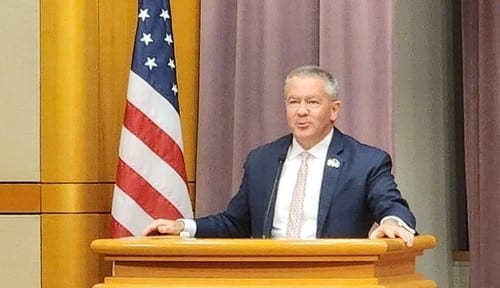
The United States is focused on ensuring that the necessary conditions for the transfer of wartime operational control (OPCON) to South Korea are met "as soon as possible," a senior U.S. diplomat said Thursday. Assistant Secretary of State for East Asian and Pacific Affairs Michael DeSombre stated during a House Foreign Affairs Committee hearing that while the U.S. understands South Korea's desire to expedite the transfer, various conditions must be satisfied to maintain deterrence on the Korean Peninsula.
DeSombre noted that both Seoul and Washington are pursuing the OPCON transition under a "conditions-based" agreement. South Korean President Lee Jae Myung's administration is working to meet these conditions, which include Seoul's capability to lead combined forces, its strike and air defense capabilities, and a stable regional environment, with the goal of achieving the transfer before the end of its term in 2030.
However, there appears to be a divergence in timelines between the two allies. While Seoul officials are reportedly seeking an earlier transition, potentially as early as next year, U.S. Forces Korea Commander Gen. Xavier Brunson has indicated that the allies aim to meet the conditions by no later than the first quarter of 2029.
South Korea originally handed over operational control of its troops to the U.S.-led U.N. Command during the Korean War (1950-53). This control was later transferred to the allies' Combined Forces Command in 1978. Seoul regained peacetime OPCON in 1994, but wartime OPCON has remained under U.S. control.