Key facts
- 70% of Americans believe birthright citizenship is a constitutional right, according to a new survey.
- 15% of respondents do not believe the Constitution guarantees birthright citizenship, and 16% are unsure.
- Democrats (86%), Republicans (53%), and independents (65%) largely support birthright citizenship.
- President Donald Trump's executive order aimed to deny citizenship to children born to undocumented parents.
- The Supreme Court's ruling addressed universal injunctions, not the constitutionality of birthright citizenship itself.
- Trump's executive order remains on hold due to ongoing legal challenges and lower court rulings.
A significant majority of Americans, approximately 70%, believe that birthright citizenship is a constitutional right, according to a recent American Family Survey. This sentiment holds across political divides, with strong support from Democrats, Republicans, and independents.
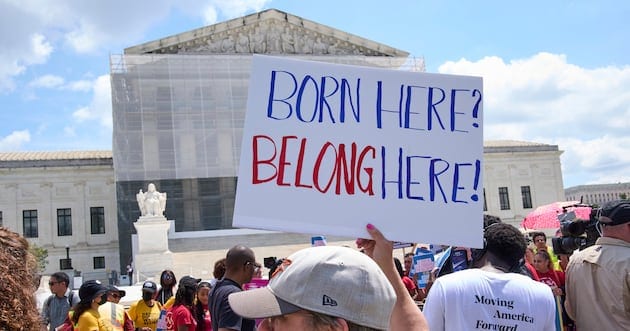
President Donald Trump's administration previously issued an executive order aiming to reinterpret the 14th Amendment's guarantee of citizenship to children born in the U.S. to parents regardless of their legal status. This move sparked legal challenges, with lower courts issuing nationwide injunctions that prevented the order's enforcement.
The Supreme Court recently ruled on the issue of universal injunctions, a 6-3 decision along conservative-liberal lines, which limited federal judges' power to issue such broad orders. However, the ruling did not explicitly decide the constitutionality of birthright citizenship itself. Consequently, Trump's executive order remains on hold, with lower court rulings continuing to play out.
Various polls indicate a consistent public approval for birthright citizenship. An Emerson College Polling survey found 68% of registered voters support it, while a Reuters/Ipsos poll showed 52% opposed ending it. A Pew Research Center survey presented closer results, with 50% in favor of granting citizenship to children of undocumented immigrants and 49% in favor of ending birthright citizenship.
Birthright citizenship, rooted in the 14th Amendment, generally grants citizenship to nearly all individuals born within the United States, even if their parents are not U.S. citizens.