All NewsEducationTVBrokers
Equities & FundsCrypto & Digital AssetsAI & TechnologyBusiness & CorporateUS Politics & PolicyGeopolitics & Global RiskMacro, Rates & FXCommodities & EnergyEuropean Politics & MarketsAsia-PacificReal Estate & Property
All NewsHome
← Back to Commodities & Energy

World food prices hit highest since late 2022 on supply risks

Created at 4 Sep · 9:21 AM1 source↑ Market-relevant
IN SHORT

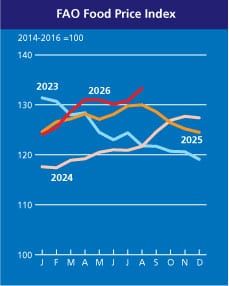
World food prices climbed in August to their highest level since late 2022, driven by a confluence of factors including extreme weather, the threat of El Nino, and ongoing conflicts in Ukraine and Iran. The FAO Food Price Index rose to 133.3 points, with grain and sugar prices reaching multi-year highs.

Key Numbers

133.3FAO Food Price Index in August
130.8FAO Food Price Index in July (revised)
17 percentbelow record peak from March 2022
2.5 pointsincrease in FAO Food Price Index from July
1.9 percentmonthly increase in FAO Food Price Index
3.3 pointsyear-on-year increase in FAO Food Price Index
2.5 percentyear-on-year increase in FAO Food Price Index
26.9 pointsbelow peak reached in March 2022
16.8 percentbelow peak reached in March 2022
116.3FAO Cereal Price Index in August
2.5 pointsincrease in FAO Cereal Price Index from July
2.2 percentmonthly increase in FAO Cereal Price Index
May 2024
highest level for Cereal Price Index since
2.6 percentmonth-on-month increase in world wheat prices
15.0 percentabove year-earlier level for world wheat prices
2.5 percentmonth-on-month increase in international maize prices
196.9FAO Vegetable Oil Price Index in August
1.1 pointsincrease in FAO Vegetable Oil Price Index from July
0.6 percentmonthly increase in FAO Vegetable Oil Price Index
June 2022highest level for Vegetable Oil Price Index since
127.9FAO Meat Price Index in August
1.2 pointsincrease in FAO Meat Price Index from July
1.0 percentmonthly increase in FAO Meat Price Index
3.4 million metric tonsreduction in global cereal production forecast
2.980 billion tons2026 global cereal production forecast
2.0 percentbelow 2025 global cereal production

Who's Involved

Food and Agriculture Organization
United Nations agency reporting on food prices
Maximo Torero
FAO Chief Economist
World food prices hit highest since late 2022 on supply risks

↳ Why This Matters

The rise in global food prices to a near two-year high signals increasing pressure on household budgets worldwide and raises concerns about food security, particularly in vulnerable regions. The confluence of adverse weather and geopolitical instability highlights the fragility of global food supply chains.

Key facts

  • World food prices reached their highest level since late 2022 in August.
  • The FAO Food Price Index increased to 133.3 points in August, up from 130.8 in July.
  • Grain prices climbed to three-year highs, and sugar prices reached a one-year peak.
  • Factors contributing to the rise include extreme weather, El Nino threats, and disruptions from the Ukraine and Iran conflicts.
  • Global cereal production forecast for 2026 was reduced by 3.4 million metric tons.

World food prices surged in August to their highest point since late 2022, according to data released by the United Nations' Food and Agriculture Organization (FAO). The FAO Food Price Index, which tracks global food commodity prices, averaged 133.3 points in August, a 1.9 percent increase from July's revised figure of 130.8 points. This marks the highest level since November 2022, though it remains significantly below the record peak seen in March 2022.

The rise in prices is attributed to a combination of factors, including extreme weather events such as heat and drought in Europe, the anticipated arrival of a severe El Nino pattern, and trade disruptions stemming from conflicts in Ukraine and Iran. These issues have unsettled agricultural markets, pushing grain prices to three-year highs and sugar prices to a one-year peak.

The FAO's Cereal Price Index saw a 2.2 percent increase in August, reaching its highest level since May 2024. This was driven by strong demand, concerns over crop prospects due to weather, and ongoing uncertainty surrounding Black Sea export flows. Wheat prices rose by 2.6 percent and maize prices by 2.5 percent month-on-month.

The Vegetable Oil Price Index also climbed 0.6 percent to its highest level since June 2022, influenced by higher palm and soy oil prices. The Meat Price Index rose by 1.0 percent, with increases in poultry, pig, and ovine meat prices.

In a separate development, the FAO revised down its 2026 global cereal production forecast by 3.4 million metric tons to 2.980 billion tons, which is 2.0 percent below the 2025 output but still represents the second-largest harvest on record. FAO Chief Economist Maximo Torero warned that the increase in global food prices signals a return of risk premiums to food markets due to converging climate shocks, geopolitical tensions, and disrupted trade logistics.

Frequently asked questions

The FAO Food Price Index is a monthly measure that tracks changes in the international prices of a basket of globally traded food commodities.

The increase is driven by extreme weather events like heat and drought, the threat of El Nino, and trade disruptions caused by the wars in Ukraine and Iran, impacting grain, sugar, and fertilizer supplies.

August prices are the highest since late 2022 but remain nearly 17 percent below the record peak reached in March 2022.

The FAO has reduced its 2026 global cereal production forecast, though it is still expected to be the second-largest harvest on record.

What Happens Next

01Monitor upcoming FAO reports for continued trends in food prices.
02Observe the impact of El Nino on global agricultural production.
03Track developments in the Ukraine and Iran conflicts and their effect on grain and fertilizer shipments.
CME Headlines
  • Performance Bond Requirements: Agriculture — Effective September 04, 2026
    3 Sep · 10:35 PM
  • Performance Bond Requirements: Agriculture and FX — Effective September 04, 2026
    3 Sep · 10:35 PM
  • Corn futures post historic August rally ahead of USDA report.
    3 Sep · 9:28 PM

How It Developed

World food prices rose in August to their highest level since late 2022.
The FAO Food Price Index averaged 133.3 points in August, up from July's revised reading of 130.8.
Grain prices reached three-year highs, and sugar prices hit a one-year peak.
Extreme heat and drought in Europe, the threat of El Nino, and trade disruptions from the Ukraine and Iran wars unsettled agricultural markets.
Escalating attacks in the Black Sea curtailed grain shipments from Russia and Ukraine.
The war on Iran strained flows of fertilizer for crops.
The FAO Cereal Price Index increased by 2.2 percent in August, reaching its highest level since May 2024.
International cereal prices increased across all major grains, supported by robust demand and weather concerns.

Sources

T1
World food prices at highest since 2022, says UNMiddle East Eye
T2
FAO Food Price Index | Food and Agriculture Organization of the United ...fao.org
T2
World food prices at highest since 2022 as supply risks mount, says FAOfreemalaysiatoday.com
T2
World food prices at highest since 2022 as supply risks mount, FAO saysmarketscreener.com

Related Stories

Oil Prices Surge on Escalating US-Iran Tensions
4 Sep · 1:30 AM
Farmers face 'astronomical' fuel price surge amid geopolitical tensions
4 Sep · 9:06 AM
US Diesel Prices Hit Record High Amid Supply Crunch and Geopolitical Tensions
3 Sep · 12:26 PM
Global Refining Crunch Could Keep Fuel Prices High Into 2027
3 Sep · 11:36 AM
Iran adds over $1B in oil revenue to foreign reserves
3 Sep · 11:06 AM