Key facts
- US ethanol exports set records in volume and value for two consecutive years.
- Growing global ethanol import demand and reduced competition from Brazil fueled the export growth.
- Canada, the EU, the UK, India, Colombia, and the Philippines were top ethanol-importing markets.
- Canada's fuel ethanol consumption grew over 50 percent between 2021 and 2025 due to national and provincial policies.
- US ethanol exports to Canada reached 3.1 billion liters (829 million gallons) in 2025.
- US ethanol exports were 7% higher in the first five months of the 2025/26 marketing year compared to the same period in 2024/25.
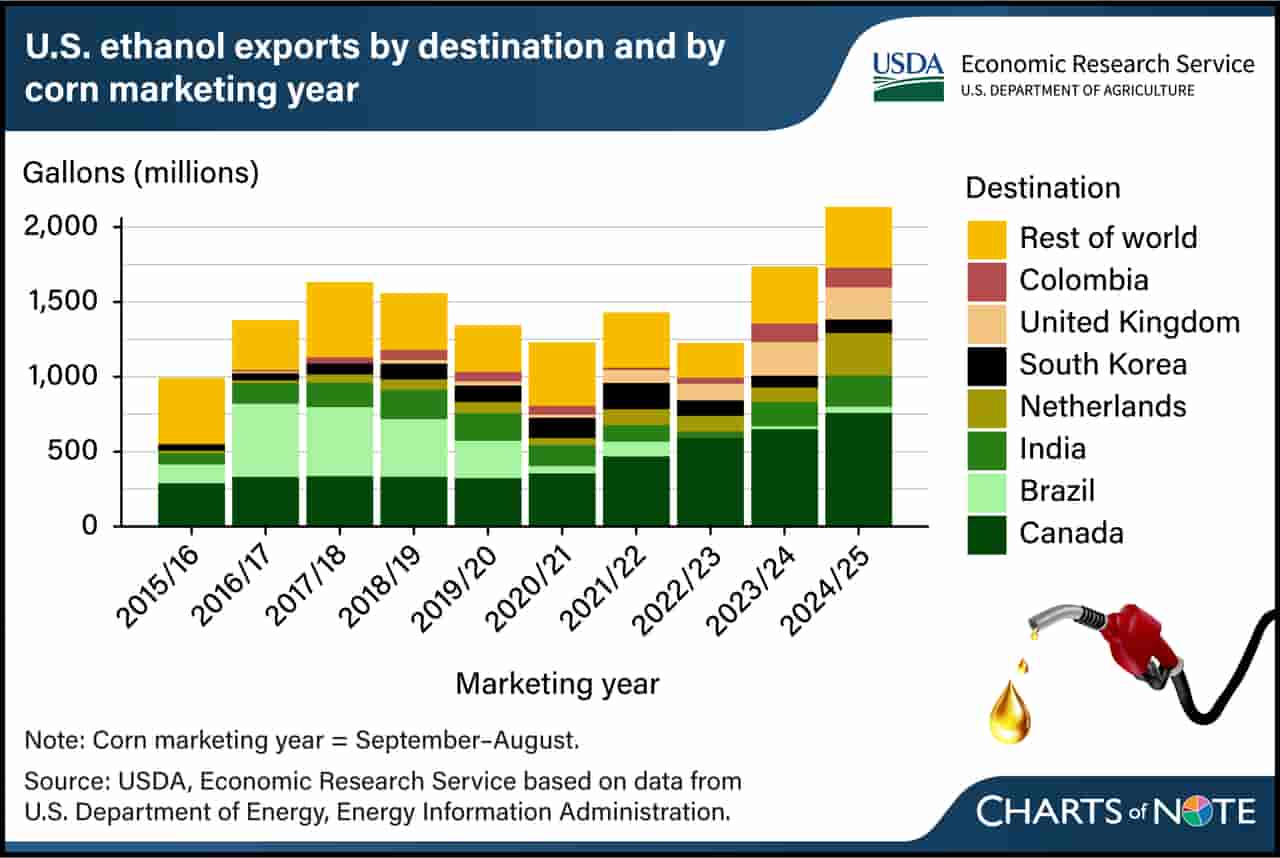
U.S. ethanol exports have achieved record-breaking volume and value for two consecutive years, a trend driven by robust global import demand and a decrease in exportable supplies from Brazil, the world's second-largest ethanol producer. Through June of 2026, U.S. exports are tracking ahead of the previous year's record pace.
In 2024, U.S. ethanol exports reached 7.4 billion liters (1.9 billion gallons), valued at $4.3 billion, with record volumes recorded in seven of the top ten importing markets. This momentum continued into 2025, with exports hitting 8.4 billion liters (2.2 billion gallons) and a value of $4.7 billion, setting new records in five key markets. Data from September through January of the 2025/26 marketing year indicate a further 7% increase in exports compared to the same period in 2024/25.
Canada remains the top importer, accounting for over a third of U.S. ethanol exports. Its demand has been significantly boosted by the national Clean Fuel Regulations and provincial policies in Ontario, Quebec, and British Columbia, which incentivize renewable fuel blending. These policies have led to a more than 50% increase in Canadian fuel ethanol consumption between 2021 and 2025.
The European Union and the United Kingdom also represent significant growth markets. While U.S. Census Bureau data showed a decline in exports to the UK in 2025, USDA estimates, using UK import data, suggest a substantial increase, with some shipments to the UK being misclassified as EU deliveries due to port storage constraints in the UK and transshipment through Rotterdam.
However, the trajectory of U.S. ethanol exports for the remainder of 2026 faces potential headwinds. These include shifts in U.S. and global biofuel policies, the establishment and implementation of new trade agreements, and the impact of high energy prices stemming from the conflict in the Middle East.