Key facts
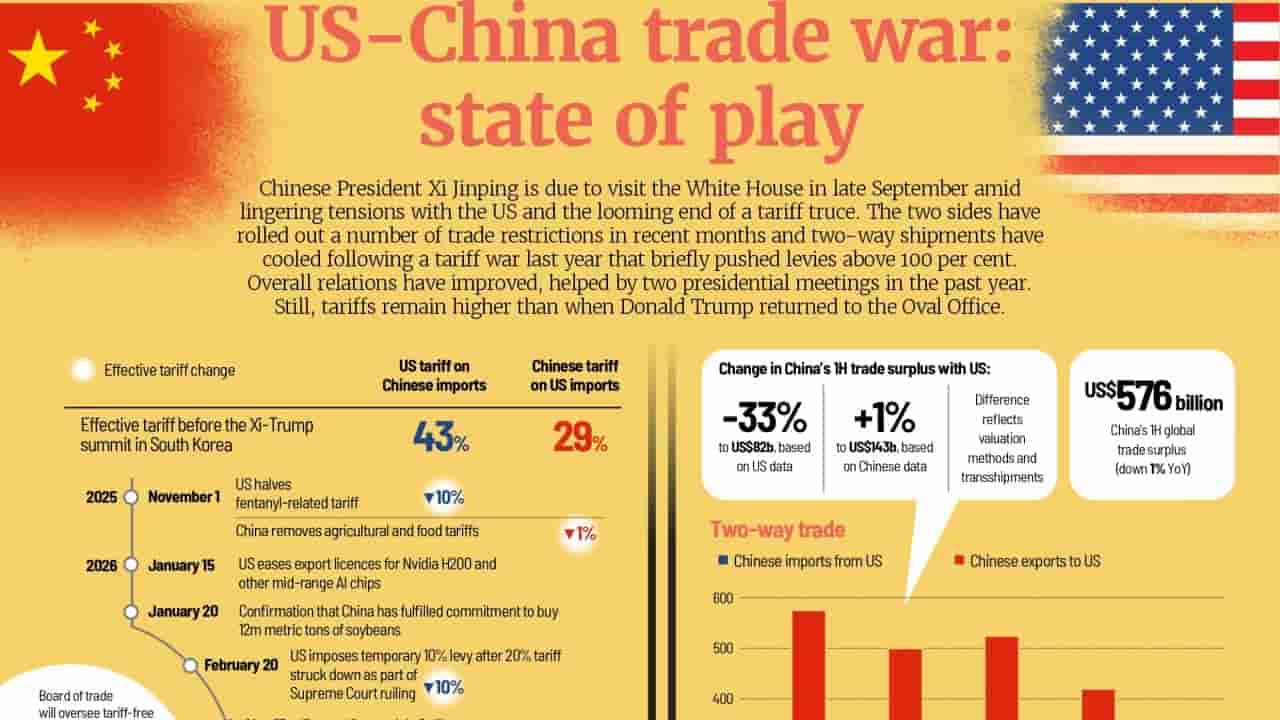
- The average US tariff on Chinese goods is approximately 33% in May 2026.
- Tariffs are stacked across four layers: MFN base rate (~3.4%), Section 301 (7.5-25%), IEEPA fentanyl tariff (20%), and reciprocal tariff (10%).
- For certain sectors like EVs, lithium-ion batteries, and solar products, the stacked tariff rate can exceed 145%.
- The 2020 Phase One trade agreement saw China meet only about 58% of its purchase targets.
- Trade diversion to countries like Mexico and Vietnam is now a standard operational practice.
As of mid-2026, the US-China trade relationship is characterized by a "tactical truce," a state of managed friction where both nations maintain competitive postures while avoiding complete economic decoupling. This dynamic reflects a fundamental shift toward "de-risking" and "friend-shoring" strategies, reshaping global logistics.
The average US tariff on Chinese goods stands at approximately 33% in May 2026, a trade-weighted blend across all imports. This figure is a result of four stacked tariff layers: the Most-Favored Nation (MFN) base rate (around 3.4%), Section 301 tariffs (ranging from 7.5% to 25% on specific HS codes), the IEEPA fentanyl tariff (20% on all Chinese imports imposed in February 2025), and a reciprocal tariff currently at 10% due to a 90-day truce extension running through August 2026.
For certain sectors, including electric vehicles (EVs), lithium-ion batteries, and specific solar products, the cumulative tariff rate can exceed 145%. For unlisted consumer goods, the rate can be as low as 23%. The historical development of these tariffs includes the 2018-2019 Section 301 impositions, the 2020 Phase One trade deal which saw China meet only about 58% of its purchase targets, and subsequent additions by the Biden administration. The Trump 2.0 era saw the imposition of the IEEPA tariff and a reciprocal tariff regime that fluctuated before settling at lower rates.
The failure of the 2020 Phase One agreement has led to a "managed competition" model, featuring selective tariff negotiations, enhanced export controls, and strategic use of "Entity Lists." Trade diversion toward countries like Mexico, Vietnam, and other ASEAN nations has become the operational standard, and companies are increasing safety stock duration to between 60-90 days. The US continues to maintain significant Section 301 tariffs on approximately $300 billion of Chinese imports, which policy analysts describe as a "high fence, small yard" approach, maintaining broad tariffs while increasing duties on strategic sectors.