Key facts
- Two firefighting helicopters collided west of Athens on Sunday while battling wildfires.
- Two people died in the mid-air collision, while two others survived.
- The wildfire northwest of Athens has been burning for four days, destroying homes and farmland.
- Preliminary investigation suggests faulty power lines caused the wildfire outbreak.
- Two Greek nationals have been arrested in connection with the wildfire's origin.
Two firefighting helicopters collided west of Athens on Sunday while battling wildfires, prompting a search and rescue operation. The incident occurred as Greece continues to battle wildfires across the country.
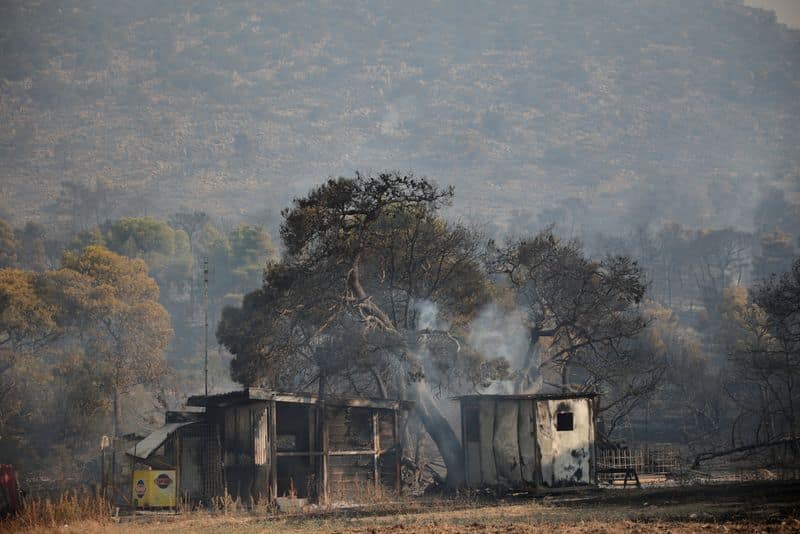
Hundreds of Greek firefighters battled a wildfire northwest of Athens for a fourth day on Monday after blazes fanned by strong winds gutted homes, thousands of hectares of farmland and pine forests, and forced emergency evacuations by land and sea. Two people on a firefighting helicopter died on Sunday near the seaside community of Psatha, about 40 km (25 miles) from Athens, after a mid-air brush with a second helicopter, whose two crew survived.
More than 400 firefighters and 21 aircraft were deployed near the communities of Kandili and Agia Skepi on Monday as plumes of thick black smoke and red flames engulfed lush pine forests. Heavy machinery was being used to carve fire breaks to prevent the wildfire reaching homes, a Greek fire brigade official said.
Europe has been ravaged by wildfires this summer after a period of record-breaking heatwaves and little rain — conditions that scientists say have been exacerbated by a fast-changing climate. France and Spain have been particularly hard hit, although huge blazes there abated over the weekend, providing some respite.
Sunday's air crash follows a grim week for Greek emergency services. Three firefighters were killed in two separate incidents in Crete and on the Peloponnese on July 29. Greek authorities are trying to ascertain the cause of the mid-air crash of the two helicopters, which occurred at low altitude.
"The only thing we can say at this stage is that the formation of the two helicopters was not appropriate," said Faidon Karaiosifidis, an aviation accident investigator. "Their vertical and horizontal separation, as well as the descent rate, were inadequate."
Deputy Climate Crisis Minister Kostas Katsafados told public broadcaster ERT that strong and erratic winds over the past few days had prevented water bombers drawing up seawater, leaving ground forces battling the blazes on their own.
Preliminary investigation suggests that a fire that broke out in the nearby area of Boeotia last week and travelled 25 km (15 miles) was caused by sparks from vibrating conductors on a private power line transmitting electricity from wind turbines, the fire brigade said. An electrical engineer and a contractor have been arrested and are being investigated for arson. Faulty power lines have been the leading cause of major wildfires in Greece in recent years, ahead of arson and negligence.