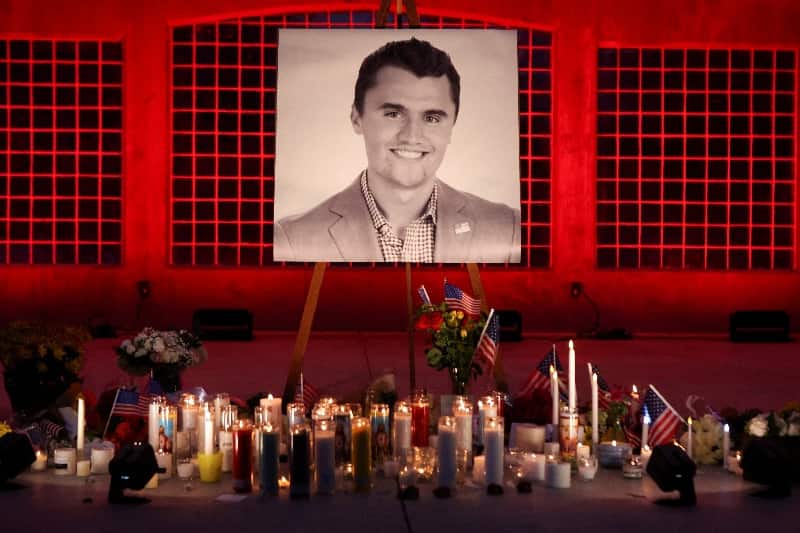
Key facts
- Turning Point USA (TPUSA) has seen growth a year after the assassination of its founder, Charlie Kirk.
- Some members and observers feel no one has been able to fill the void left by Kirk's leadership and charisma.
- Inquiries to start new TPUSA campus chapters surged immediately after Kirk's death.
- Internal divisions and a perceived shift in direction have led some chapters to distance themselves from TPUSA.
- TPUSA has launched a new campaign to continue Kirk's tradition of campus debates.
- The man accused of Kirk's murder, Tyler Robinson, denies aggravated murder charges.
A year after the assassination of conservative activist Charlie Kirk, the organization he founded, Turning Point USA (TPUSA), is experiencing a complex period of growth and introspection. While the group saw an initial surge in interest following Kirk's death, some members and observers feel the organization has struggled to replicate his charismatic leadership and impact.
Jeb Jacobi, a student who witnessed Kirk's murder at Utah Valley University (UVU) last September, described the event as leaving a "forever stain" and noted that no one has been able to fill the void left by Kirk. He suggested the organization "doesn't have the same power, the same impact" as it did under its founder.
In the immediate aftermath of the assassination, TPUSA reported receiving over 32,000 inquiries to start new campus chapters within 48 hours. However, momentum has reportedly slowed, with internal divisions between moderate and right-wing factions noted by current members. One chapter in Arkansas reportedly changed its name to disassociate itself from TPUSA due to dissatisfaction with its direction.
Despite these challenges, some within the organization remain optimistic. Macy Gunnell, a TPUSA chapter leader who started a chapter at St. Mary's College in Indiana after Kirk's death, believes TPUSA is still growing and denies claims that it has strayed from Kirk's original vision. She expressed confidence that "this is quite literally just the beginning."
TPUSA has launched a new campaign called "Pick Up the Mic," sending debaters to campuses and high schools to continue Kirk's tradition of rhetoric. Gunnell is among the speakers featured in this initiative.
Mark Brewer, chair of the political science department at the University of Maine, noted that a dip in momentum following the loss of a charismatic leader is not unusual. He stated that Kirk's "personal status as a martyr remains very strong" and that many on the right are trying to claim affiliation with his legacy, which may have even increased.
Meanwhile, the legal proceedings continue for Tyler Robinson, the man accused of shooting Kirk. A judge recently cleared the way for a trial, with Robinson denying charges of aggravated murder.
Some students, like Jacobi, have turned to religion in the wake of Kirk's death, finding a personal relationship with Christ as a source of peace, rather than making politics their entire identity. Others, like fellow UVU student Anthony Shinkle, fear that Kirk's graphic murder and its contentious aftermath have made some young supporters hesitant to express their views or pushed them toward more extreme positions.