Key facts
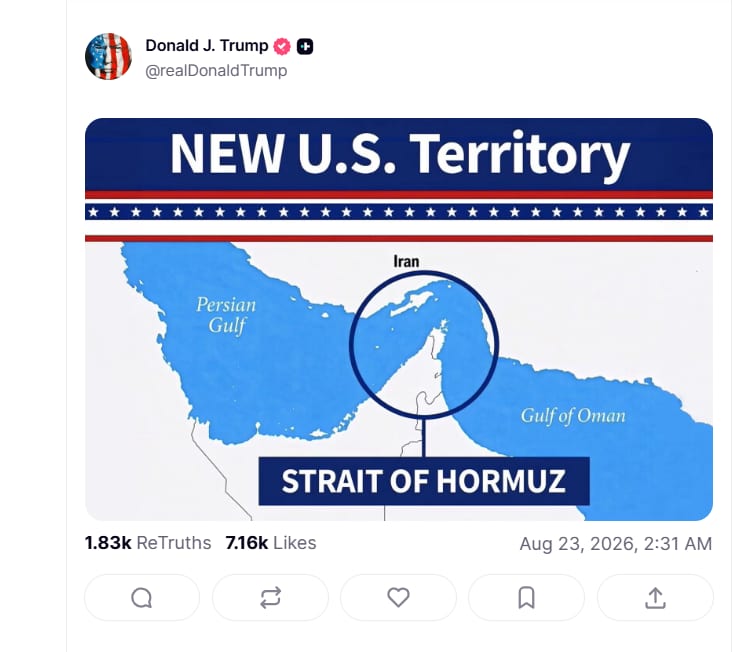
- President Donald Trump posted a map on Truth Social labeling the Strait of Hormuz as "New US Territory."
- Trump previously stated he would declare the Strait of Hormuz a US territory after the war with Iran.
President Donald Trump shared a map on social media designating the Strait of Hormuz as "New US Territory." Iran has rejected the claim, stating the strait will remain Iranian and under its command.
The escalating rhetoric and territorial claims over the Strait of Hormuz, a vital global energy chokepoint, increase geopolitical tensions and could impact global oil prices and shipping security.
US President Donald Trump has escalated rhetoric regarding the Strait of Hormuz, posting a map on his Truth Social account that labels the critical waterway as "New US Territory." This move follows his earlier public statements, including one on Long Island where he suggested a permanent US presence in the strait after the conflict with Iran concludes.
Trump claimed that the area had been cleared of Iranian mines and announced that no further talks with Iran were scheduled, as the 60-day negotiating period between Washington and Tehran expired without extension. He also reiterated his stance that Iran must not be allowed to obtain nuclear weapons, suggesting that increased gasoline prices would be a small price to pay for this security.
Iran has strongly refuted Trump's assertions. Deputy Foreign Minister Kazem Gharibabadi stated that the Strait of Hormuz "has been Iranian, is Iranian, and will remain Iranian" and that it will only be closed and opened under Iran's command. He characterized Trump's claims as "delusions."
The ongoing uncertainty surrounding the Strait of Hormuz has led to a significant reduction in traffic, with fewer than a dozen ships crossing daily. The Brent crude benchmark saw an increase to $91 a barrel following the US decision not to extend the cease-fire deal.