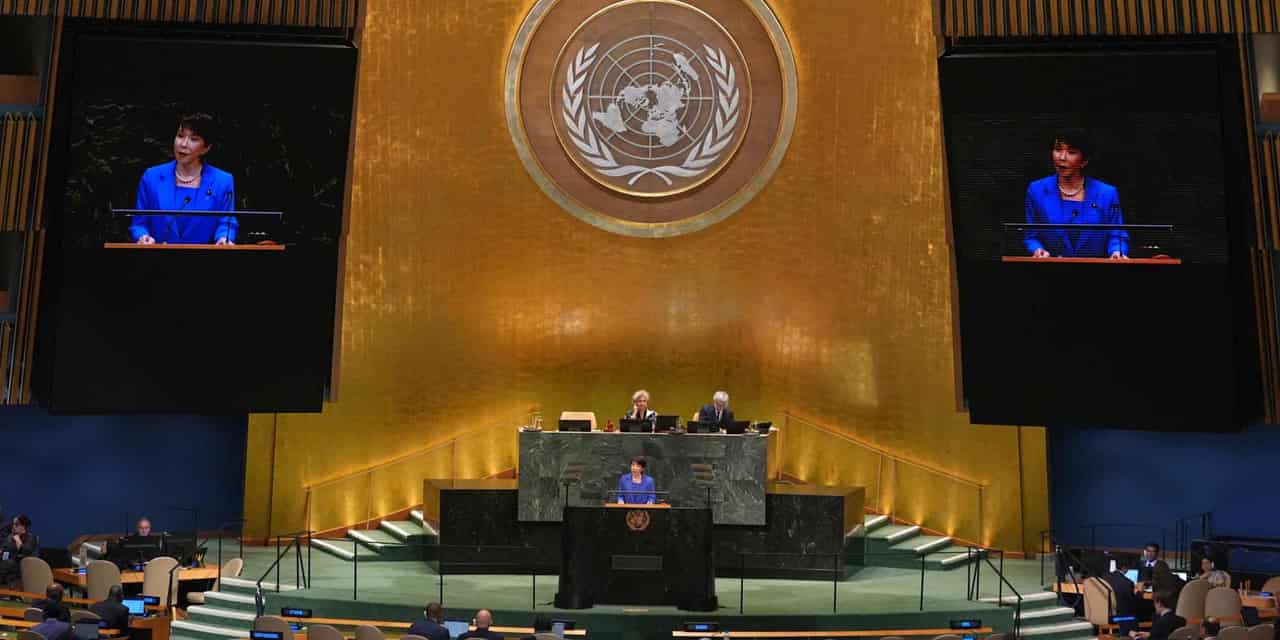
Takaichi, Trump discuss China, economic security at UN
1 source↑ Market-relevant
IN SHORT
Japanese Prime Minister Sanae Takaichi met with U.S. President Donald Trump in New York on September 22, 2026, to discuss cooperation on economic security, including AI, semiconductors, and critical minerals. The summit, held on the sidelines of the UN General Assembly, also addressed issues concerning China ahead of Trump's meeting with Chinese President Xi Jinping.
Key Numbers
30+minutes of Trump-Takaichi summit
40-minuteduration of Takaichi-Trump meeting
sevenconsecutive years Japan has been largest US investor
Who's Involved
Sanae Takaichi
Japanese Prime Minister who met with US President Donald Trump
Donald Trump
US President who met with Japanese Prime Minister Sanae Takaichi
Xi Jinping
Chinese President scheduled to meet with Donald Trump
↳ Why This Matters
The meeting between the leaders of Japan and the United States highlights the strategic alignment between the two nations on critical economic security issues and their coordinated approach to regional challenges, particularly concerning China.
Key facts
Japanese Prime Minister Sanae Takaichi met with U.S. President Donald Trump on Sept. 22, 2026, in New York.
The leaders discussed cooperation on AI, semiconductors, and critical minerals.
They reaffirmed bilateral economic security cooperation.
Takaichi and Trump discussed issues concerning China ahead of Trump's meeting with Xi Jinping.
They agreed to coordinate closely on China-related matters and economic coercion.
Takaichi and Trump reaffirmed cooperation on defense and North Korea's nuclear and missile programs.
Japanese Prime Minister Sanae Takaichi met with U.S. President Donald Trump in New York on September 22, 2026, to coordinate on China and align policies in areas of mutual interest, including investments, critical minerals, and artificial intelligence. The meeting took place on the sidelines of the United Nations General Assembly.
Takaichi told Trump that the security environment in Asia and elsewhere is becoming increasingly severe, and she wanted to demonstrate the robustness of the US-Japan alliance. At the outset of their nearly 40-minute meeting, Takaichi stated, "Thanks to Donald's leadership and also my own leadership, our bilateral economic security cooperation in areas such as AI, semiconductors and critical minerals has been steadily advancing." Trump praised Takaichi, calling her a "friend" and predicting she would be a "great prime minister."
The summit occurred a day before Chinese President Xi Jinping's scheduled arrival in Washington for a three-day state visit. The leaders exchanged views on various issues involving China, including economic security, and agreed to continue working closely together. Takaichi emphasized that Japan considers it important for US-China relations to contribute to international stability. The two leaders also reaffirmed their commitment to strengthening bilateral economic ties, with Takaichi noting Japan's seven consecutive years as the largest investor in the United States. They also discussed North Korea's nuclear and missile programs and the International Criminal Court, with Takaichi outlining Japan's position on the rule of law.
This meeting followed a trilateral discussion on Monday involving the top diplomats of Japan, the United States, and South Korea, who released a joint statement opposing "economic coercion," a veiled reference to China. Japan and China have experienced diplomatic tensions since Takaichi's November statement suggesting an attack on Taiwan could be an existential threat to Japan, leading to Chinese political and economic reprisals.
Frequently asked questions
The UN General Assembly is one of the six principal organs of the United Nations, serving as the main deliberative, policymaking and representative organ. It is comprised of all 193 Member States of the UN, providing a unique forum for multilateral discussion of the full spectrum of international issues covered by the Charter of the United Nations.
Critical minerals are non-fuel mineral and mineral-based energy materials that are essential for the economy and national security, and whose supply chains are vulnerable to disruption. Examples include rare earth elements, lithium, cobalt, and copper.
Economic coercion refers to the use of economic power by one country to influence the political or security decisions of another country, often through measures like trade restrictions, sanctions, or investment limitations.
What Happens Next
01Donald Trump is scheduled to meet with Chinese President Xi Jinping on Thursday, September 24, 2026.
✉Newsletter
PiQ Daily
Pick the topics you care about. Get only what matters, on your cadence.