Key facts
- Okaloosa County bought the ship and bills the project as the world's largest artificial reef.
- Organizers said no explosives were used; holes cut in the hull and decks were meant to sink it gradually and level.
- The upper deck is expected to sit about 50 feet beneath the surface, organizers said.
- The ship will join more than 500 smaller sunken sites in the Destin-Fort Walton Beach Artificial Reefs.
- David Lawrence of the SS United States Conservancy said the goal was to make sure the ship was not lost forever.
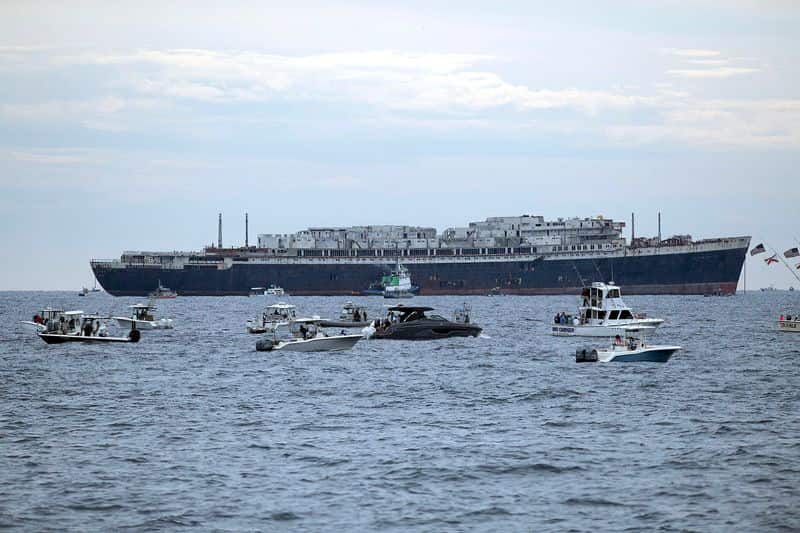
The SS United States, the largest passenger ship ever built in America and the world's fastest, headed for the sea floor near Florida on Wednesday in a deliberate sinking designed to turn it into the world's biggest artificial reef, Reuters reported on November 11, 2026.
The finale to a year-long preparation process, 75 years after the ship was first launched, was shown in a livestream with aerial views of the rusted hulk, stripped of its two smokestacks, settling slowly into calm waters of the Gulf of Mexico. Dozens of tugboats and recreational vessels accompanied the liner as it was towed out for its final voyage.
Crews spent months removing environmentally unsafe materials, including residual fuel, wiring, glass and ductwork, along with objects that could entangle scuba divers. They then cut holes through the hull and decks to ensure a gradual, level and uniform sinking, according to a fact sheet posted online by project organizers. No explosives were used, and passageways were cut through the interior for marine life.
If all goes as planned, the vessel will rest upright at a depth of 180 feet off Destin, Florida, a resort town and fishing destination, with the upper deck about 50 feet beneath the surface, organizers said. The sinking began at about 1 p.m. CST and was so slow that most of the hull remained well above the surface as the sun set.
The ship, a post-World War Two ocean liner that carried the rich and famous across the Atlantic at speeds still unmatched, was retired from service in 1969 as commercial air travel grew. It sat moored in Philadelphia for nearly 30 years before authorities in Okaloosa County, in Florida's panhandle, bought it as part of a $13 million project.
"It was our goal to make sure that she wasn't lost forever," David Lawrence, a board member of the SS United States Conservancy, which sold the ship to Okaloosa County, told the Public Broadcasting System. After permission from the US Coast Guard and other agencies, the vessel was towed to a shipyard in Mobile, Alabama, for preparation.
The ship will join more than 500 smaller underwater sites made from sunken vessels that form the Destin-Fort Walton Beach Artificial Reefs.