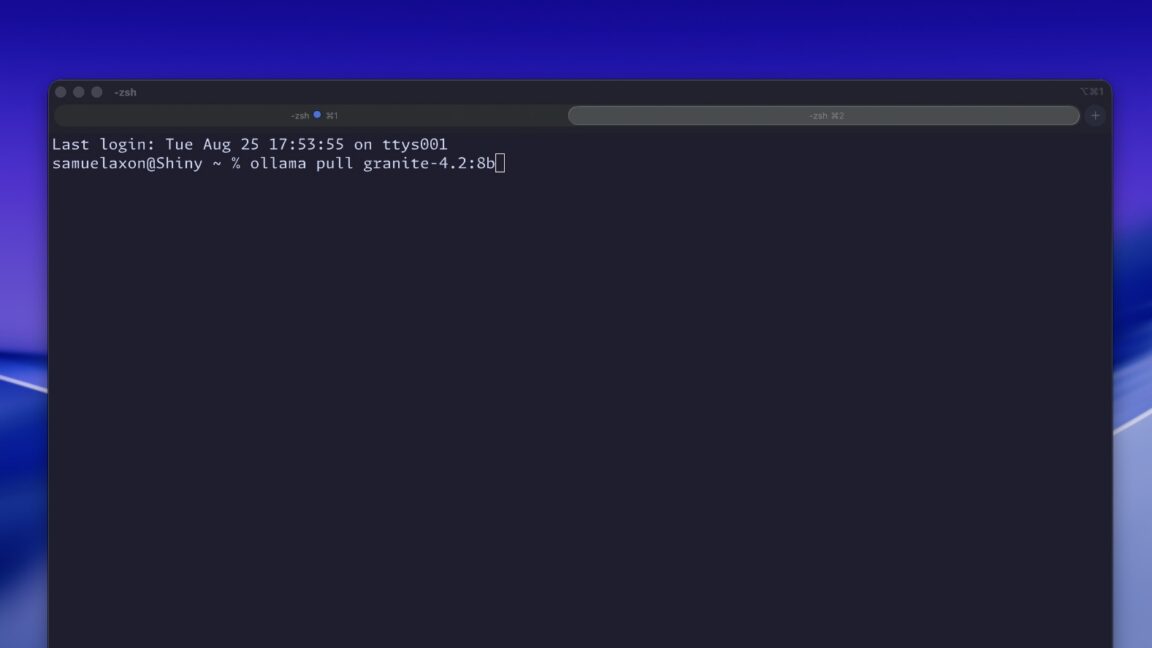
IBM has introduced its latest open-weight large language models, the Granite 4.2 family, designed for self-hosting and enterprise deployment. These models are available in three sizes: 3 billion, 8 billion, and 30 billion parameters, all utilizing a decoder-only architecture. A key feature across all variants is a native 128,000-token context window.
The 8B and 30B parameter models have undergone specialized training using agentic reinforcement learning, enhancing their ability to perform tasks such as using the terminal, searching the web, and interacting with external tools. While the 3B model also supports tool usage, it lacks this specialized training.
IBM highlights Granite 4.2 as a "reasoning-focused" release. This refers to functional reasoning capabilities, enabling models to process information through multiple steps, akin to "chain-of-thought" processing, which can lead to more rigorous and accurate responses, albeit potentially at the cost of slower response times and higher compute demands.
The company's strategy with the Granite models, including this latest iteration, appears to prioritize predictable enterprise deployments over cutting-edge speed or innovation. This approach aligns with a broader industry trend exploring local, self-hosted models as cost-effective alternatives to frontier cloud-based models, driven by concerns over API fees and compute costs.