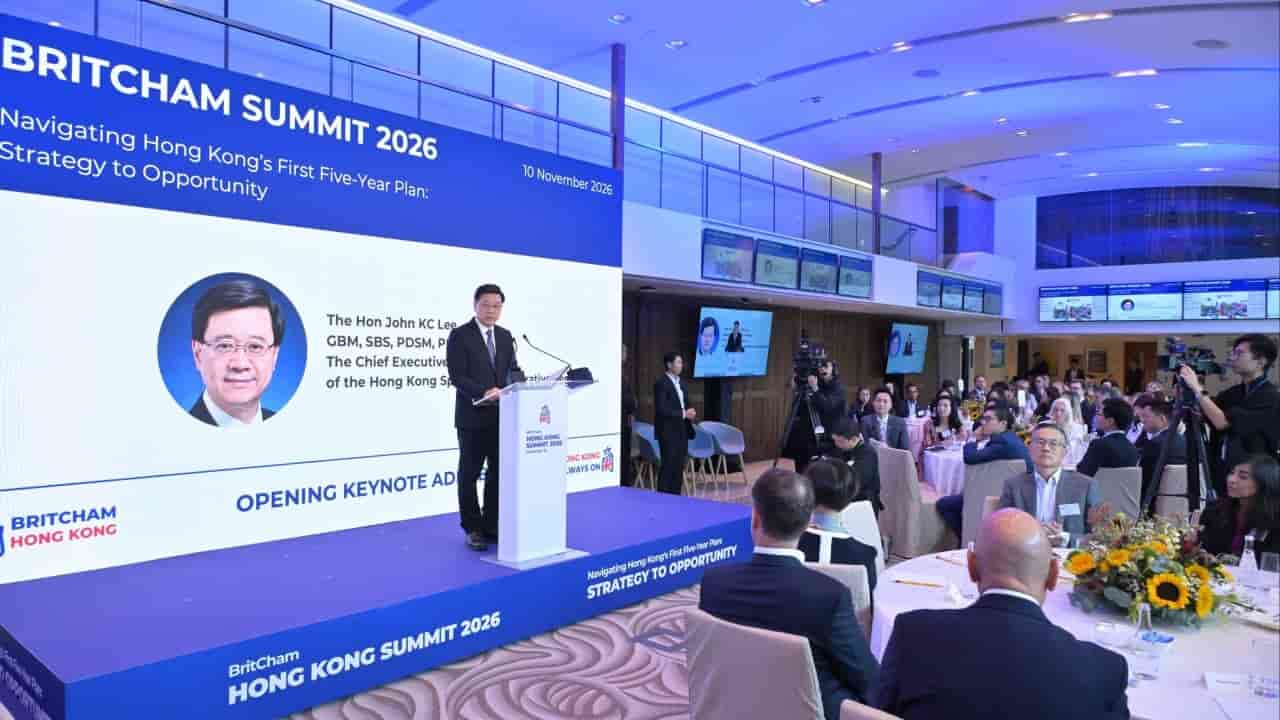
Hong Kong Chief Executive John Lee Ka-chiu said on November 10 that the United Kingdom remains a "much valued business partner" to the city, and invited British companies, investors and universities to explore opportunities in the Northern Metropolis development near the mainland Chinese border.
Speaking at the annual summit of the British Chamber of Commerce in Hong Kong, Lee pointed to the scale of the economic relationship. He said 770 British companies had a presence in the city last year, up 7% year on year, and that merchandise trade between the two places reached nearly $20 billion last year, up 26% over 2024. The UK ranked fourth in inward direct investment into Hong Kong and sixth in outward direct investment from the city at the end of 2024, he said.
Lee said Hong Kong's first five-year plan reinforced the city's "four centres and one hub": its status as an international financial, shipping and trade centre, its development into an international innovation and technology centre, and its role as a hub for high-calibre talent. He identified the Northern Metropolis as a key growth engine under the plan and a way to deepen Hong Kong's participation in the Greater Bay Area, a cluster of some 88 million people with a combined GDP comparable to the world's tenth-largest economy.
The Northern Metropolis project, adjacent to Shenzhen, will include three university towns spanning more than 1,000 hectares, with 300 hectares dedicated to campuses and the remainder to technology, industry, residential and recreational development. Lee invited UK companies, investors, universities and research institutions to explore opportunities there in life and health technology, AI, robotics and microelectronics.
He also noted that Hong Kong's five universities rank among the world's top 100 and said the time was ripe to expand post-secondary collaboration with the UK. He pointed to a recent London talent showcase, part of three UK events that together drew more than 4,500 visits, as reflecting British interest in career opportunities in Hong Kong.
Lee stressed the complementary nature of the relationship, citing shared financial standards and different time zones. "With our similar financial standards, and different time zones, one of us is on the day shift, while the other is on the night shift, covering the whole clock together," he said.