Key facts
- Hoffman EV showcased the Badger, a converted Tesla Model 3, at the SEMA trade show in Las Vegas.
- The Badger reuses the battery, motors, computers, cameras, interior screens, wiring and seats from older Tesla Model 3s.
- Hoffman said the Badger's current highway range is about 150 miles, a figure he called "probably unacceptable."
- Hoffman EV is targeting 2027 for reservations and production and predicts it can build about 100 units annually.
- The company's target pricing is about $10,000 for the chassis, $40,000 for a body kit and $10,000 for the build itself.
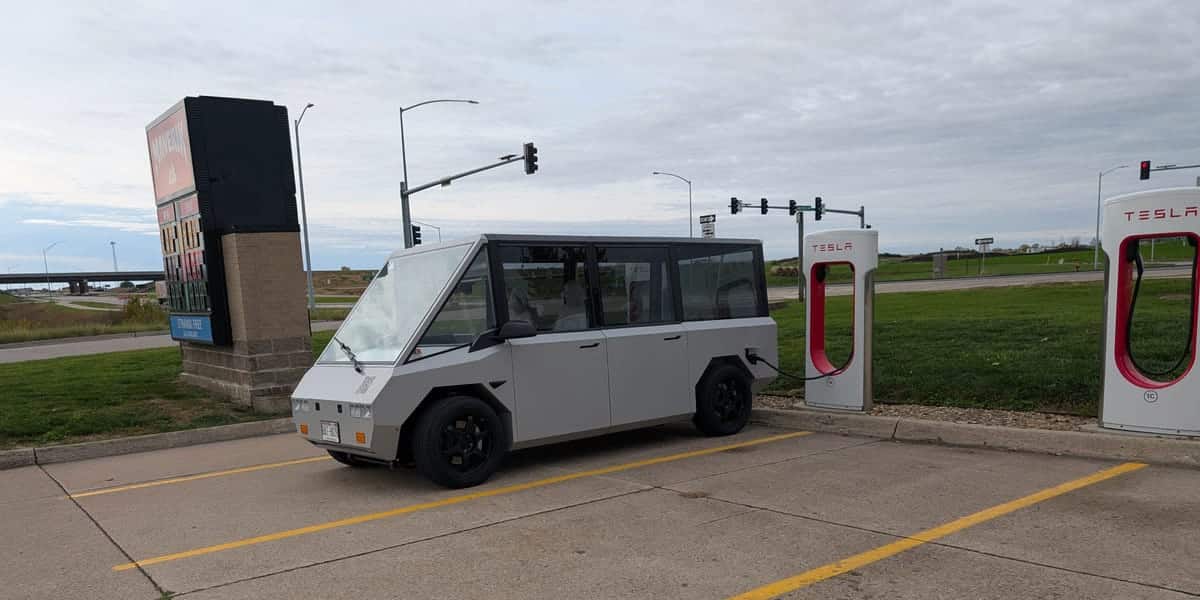
Hoffman EV, a six-year-old Wisconsin-based company founded by Geoffrey Hoffman, showcased the Badger at the SEMA trade show in Las Vegas. The vehicle is a converted Tesla Model 3 that Hoffman described as "dorky-looking" and that serves as an off-road toy, cargo van and Tesla recycling project.
The Badger reuses the battery, motors, computers, cameras, interior screens, wiring and seats from older Tesla Model 3s, with the company wrapping the vehicle in a new aluminum body. It gets access to the Tesla Supercharger network, Tesla's software updates and Tesla's semi-autonomous driving tech, so long as Tesla CEO Elon Musk does not restrict it. Tesla has no involvement in the project.
Hoffman drove the Badger to Las Vegas and back for SEMA, but said its current highway range is only about 150 miles, a figure he called "probably unacceptable." The company has set a target for 200 miles of highway range on its next prototype and is working on aerodynamics to reduce wind noise and improve range.
Hoffman EV is targeting 2027 for reservations and production and predicts it can build about 100 units annually. Its current target pricing is about $10,000 for the chassis, $40,000 for a body kit and $10,000 for the build itself. Add a roughly $20,000 donor Model 3, and the Badger could cost about $70,000 before taxes. The company is also debating whether to start by selling fully assembled cars or kits for customers to piece together.
Hoffman said he knows the company is not expected to become a mass-volume seller. "I think I have a really good concept here, or at least a lot of smart people have told me so," he said. "It isn't going to fill any gaps in the market at such low quantity or solve our climate crisis, but it should make some people happy."