Key facts
- Google DeepMind has released Gemini Robotics 2.0, an AI system designed for robots.
- The new version offers improved dexterity, environmental analysis, and multi-robot collaboration.
- Gemini Robotics ER 2, a vision language model, can process live video feeds for real-time task monitoring.
- The system can identify task completion moments with nearly 90% accuracy and understand failures in real-time.
- Gemini Robotics 2.0 includes vision-language-action models that generate robot movements from instructions.
- A new safety benchmark, ASIMOV-Agentic, evaluates models for safe operation and human assistance calls.
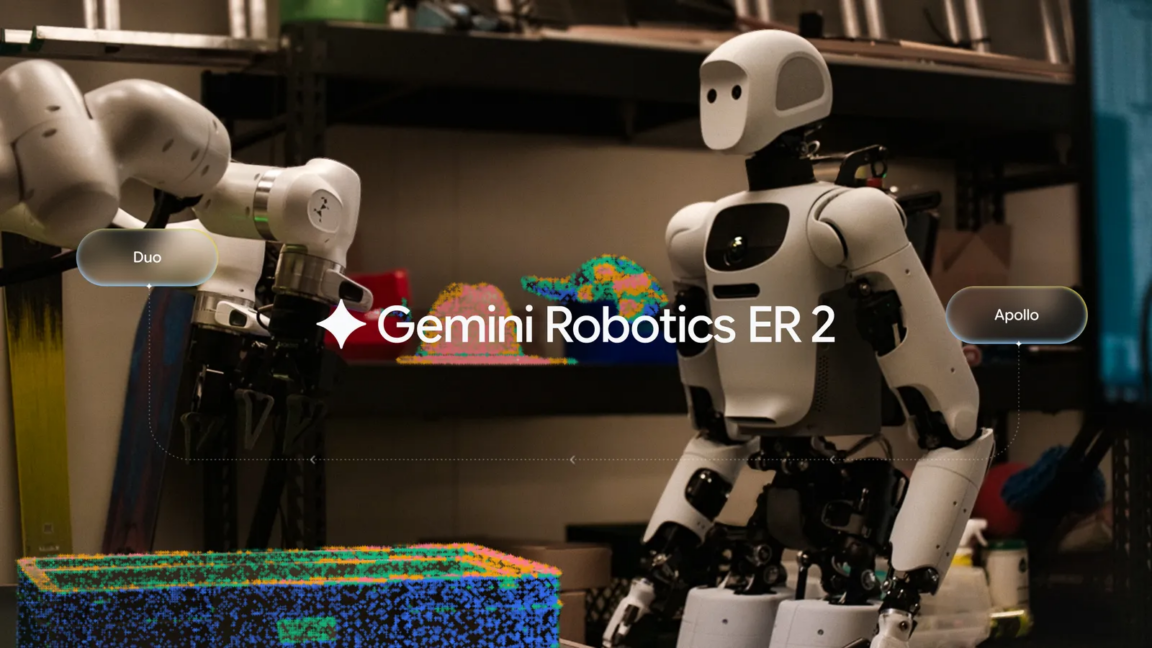
Google DeepMind has unveiled Gemini Robotics 2.0, an updated AI system aimed at creating more capable and generalist robots. The new release features a trio of sub-models designed to enhance robots' dexterity, their ability to analyze changing environments, and to facilitate collaboration between multiple robots.
The core of the upgrade is Gemini Robotics ER 2, an embodied reasoning model that processes live video feeds from robot cameras. This allows the AI to track progress, identify critical moments for task completion with high accuracy, and understand failures in real-time, enabling robots to retry specific steps rather than restarting entire tasks. Google claims ER 2 achieves nearly 60% accuracy in classifying video frame completeness and nearly 90% accuracy in identifying key moments for task execution.
This enhanced understanding also underpins the system's ability to support multi-robot collaboration, as demonstrated in videos showing robots working together without interference. Beyond understanding, Gemini Robotics 2.0 incorporates vision-language-action models, including an offline, low-latency version, which generate robot actions based on instructions, akin to generative AI for text or images. These models can adapt to new robot designs with minimal training data.
Google DeepMind emphasizes safety in its robotics development. Gemini Robotics 2.0 integrates traditional physical safety measures with AI safety frameworks. A new safety benchmark, ASIMOV-Agentic, has been introduced to evaluate models on their ability to refuse unsafe actions, assess task safety, and call for human assistance when necessary. The company states that ER 2 is its safest model to date, demonstrating an ability to recognize human proximity and halt actions accordingly.