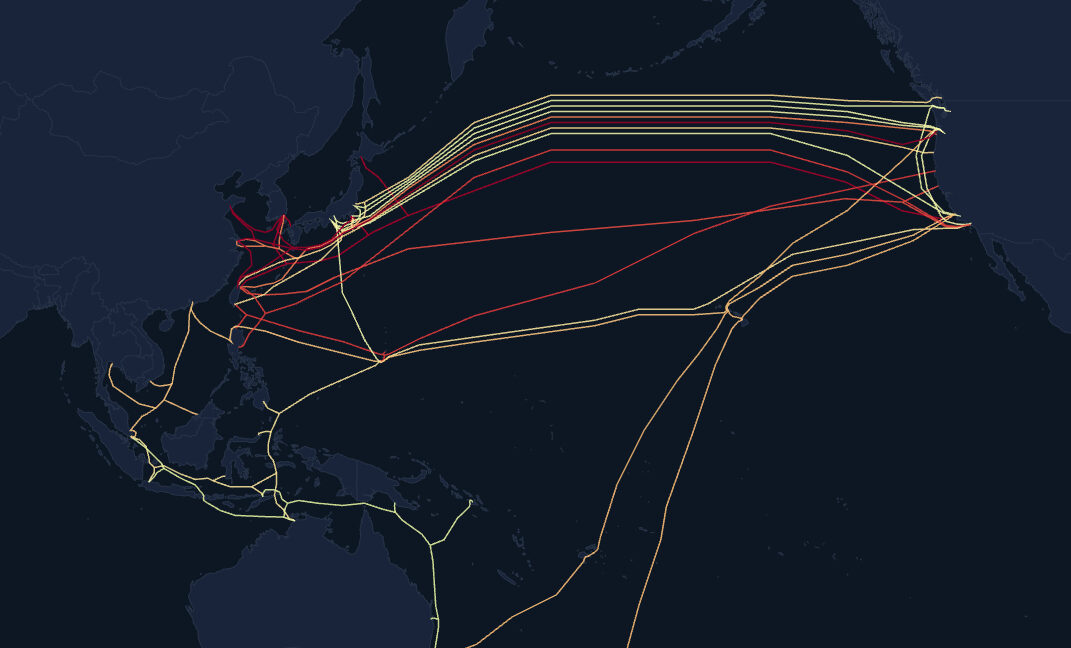
Key facts
- US-owned trans-Pacific cables face growing risks from sabotage and China's gray zone tactics.
- A report by the China Strategic Risks Institute identified Google and Meta cables as high-risk.
- Taiwan, Japan, and the Philippines are identified as areas with the highest cable risk.
- Chinese research ships have been observed spending significant time near undersea cables.
- Disruption to a single trans-Pacific cable could overwhelm current capacity between the US and Indo-Pacific.
Trans-Pacific undersea cables, including those owned by major US companies like Google and Meta, are facing increased risks of sabotage, according to a September 2026 report by the China Strategic Risks Institute. The report, commissioned by the US-China Economic and Security Review Commission, highlights Taiwan, Japan, and the Philippines as areas of highest concern due to China's territorial claims and busy shipping lanes. The index used to assess risk factored in cable route depth, nearby shipping traffic, ownership, China's exclusive economic zone, and connections to Taiwan. Google's TPU, Meta's ORCA, and Verizon's E2A cable projects were identified as being among the most at risk. A separate analysis by the Center for Strategic and International Studies noted that Chinese research vessels have spent an unusual amount of time surveying undersea cables. The report also references past incidents where Chinese-owned vessels have been implicated in cable damage, including a case in 2025 where a Chinese captain was convicted in Taiwan.