All NewsEducationTVBrokers
Equities & FundsCrypto & Digital AssetsAI & TechnologyBusiness & CorporateUS Politics & PolicyGeopolitics & Global RiskMacro, Rates & FXCommodities & EnergyEuropean Politics & MarketsAsia-PacificReal Estate & Property
All NewsHome
← Back to European Politics & Markets

Germany's AfD eyes historic win in Saxony-Anhalt election

Created at 30 Aug · 11:06 AM1 source↑ Market-relevant
IN SHORT

The far-right Alternative for Germany (AfD) party is polling at 41% in Saxony-Anhalt, potentially securing an absolute majority and its first state government since WWII. A victory could impact support for Ukrainian refugees and educational ties with Russia.

Key Numbers

41%AfD polling in Saxony-Anhalt
39,000Ukrainians in Saxony-Anhalt
2.1 millionSaxony-Anhalt population
36%AfD polling in Mecklenburg-Vorpommern
28%AfD nationwide polling

Who's Involved

Ulrich Siegmund
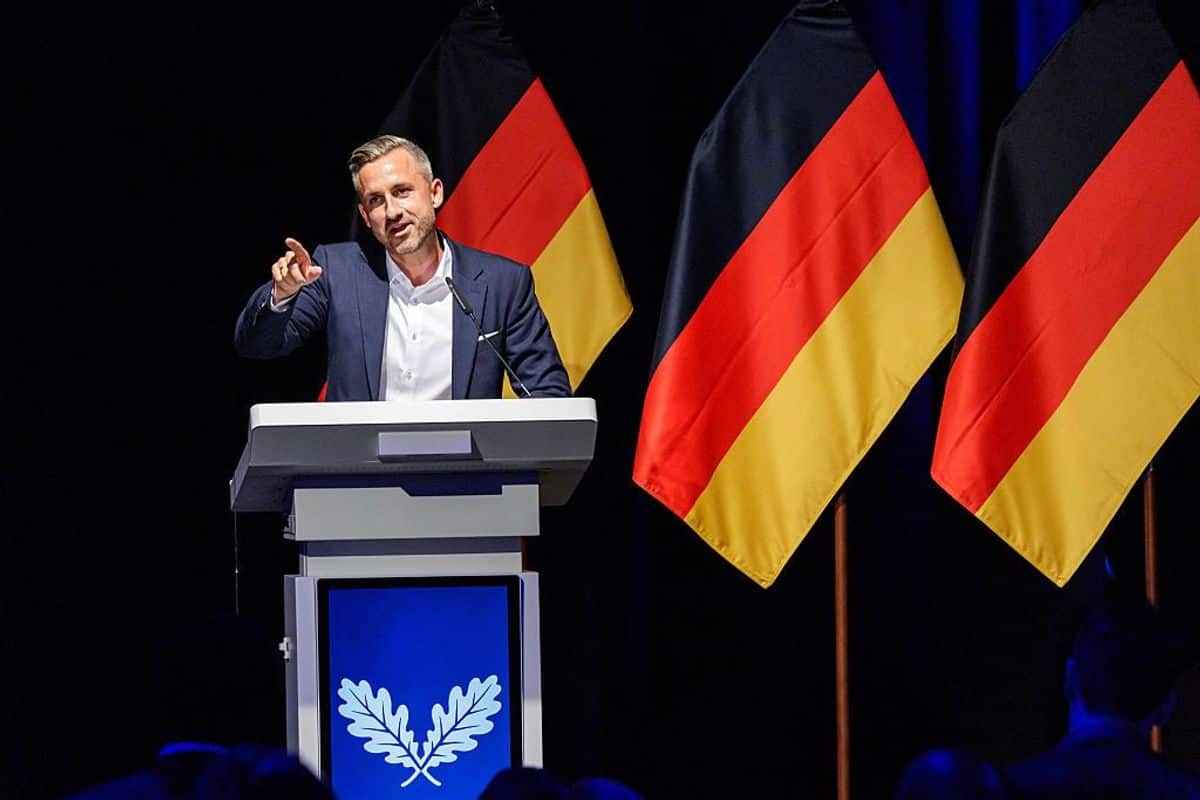
AfD's main candidate in Saxony-Anhalt and party leader
Alternative for Germany (AfD)
Far-right political party
Anna-Sophie Heinze
Political scientist at Leuphana University Lüneburg
Ursula Münch
Director of the Academy for Political Education in Tutzing
Marcel Lewandowsky
Political scientist at Martin Luther University Halle-Wittenberg
Friedrich Merz
Chancellor of Germany and leader of the CDU/CSU
Germany's AfD eyes historic win in Saxony-Anhalt election

↳ Why This Matters

A potential AfD victory in Saxony-Anhalt could reshape Germany's political landscape, impact its foreign policy regarding Russia and Ukraine, and influence European politics. It also raises concerns about the normalization of far-right extremism and its potential implications for minority groups and democratic institutions.

Key facts

  • The far-right Alternative for Germany (AfD) party is projected to win an absolute majority in the Saxony-Anhalt state election on September 6.
  • The AfD's platform includes reducing support for Ukrainian refugees and increasing educational ties with Russia.
  • A victory would give the AfD representation in the Bundesrat, Germany's federal legislative body.
  • The AfD is also leading in polls for upcoming elections in Mecklenburg-Vorpommern and is competitive in Berlin.
  • Other German parties have an agreement not to form coalitions with the AfD, potentially limiting its direct governmental power.

Germany's far-right Alternative for Germany (AfD) party is poised for a historic victory in the upcoming Saxony-Anhalt state election, potentially leading to the country's first far-right state government since World War II. Polling at 41%, the AfD's local branch, which has been classified as 'confirmed far-right extremist' by German security services, stands a strong chance of winning an absolute majority.

The party's platform, led by controversial figure Ulrich Siegmund, promises a significant departure from current German policy, including reduced support for Ukrainian refugees and a revitalization of educational and economic ties with Russia. The AfD frames these policies as a move to free Germany from what it calls 'anti-Russian' policies that are not in the nation's interest.

A win in Saxony-Anhalt would not only send a strong signal to the state's approximately 39,000 Ukrainians but also grant the AfD a seat in the Bundesrat, Germany's federal legislative body. This position could allow the party to influence federal legislation, advocate against energy sanctions on Russia, and push for the relaunch of the Nord Stream gas pipelines. Concerns have also been raised about potential intelligence leaks to Russia due to the state administration's access to sensitive information.

This election is seen as a crucial test for the rising AfD, which is also leading in polls for the September 20 elections in Mecklenburg-Vorpommern and holds a strong position in Berlin. The party's growing popularity is attributed to a 'wave of normalization' and a radicalization that is becoming increasingly socially acceptable, according to political scientists. However, experts suggest that a victory in Saxony-Anhalt may not automatically translate into wins in other states due to existing 'firewall' agreements among other parties not to form coalitions with the far-right.

Frequently asked questions

The AfD is polling at 41% in Saxony-Anhalt, with projections indicating a strong chance of winning an absolute majority in the upcoming election.

The AfD proposes cutting financial support for Ukrainian refugees, abolishing their 'war refugee' status, and restoring student exchanges and expanding Russian language courses with Russia.

A seat in the Bundesrat would allow the AfD to influence federal legislation, potentially delay bills, and advocate against aid to Ukraine and energy sanctions on Russia.

Other parties have an agreement, known as the 'firewall,' not to work with the far-right AfD, rooted in Germany's historical experience with Nazism and concerns about the party's radical positions and alleged security threats.

What Happens Next

01Saxony-Anhalt state election on September 6.
02Elections in Mecklenburg-Vorpommern and Berlin on September 20.

How It Developed

The AfD's Saxony-Anhalt branch, classified as 'confirmed far-right extremist,' is polling at 41% ahead of the Sept. 6 election.
The party's manifesto includes stricter immigration measures and reduced financial support for Ukrainian refugees.
AfD leader Ulrich Siegmund pledges to restore student exchanges with Russia and expand Russian language courses.
A victory would grant the AfD a seat in the Bundesrat, potentially delaying federal legislation and advocating against aid to Ukraine.
The AfD is also leading polls in Mecklenburg-Vorpommern and holds a strong position in Berlin for elections on Sept. 20.
Experts note that while a Saxony-Anhalt win is likely, coalition talks may be hindered by other parties' agreement not to work with the far-right.
The AfD's growing support is influencing public debate and making extremist statements more socially acceptable, according to experts.
The party, which originated as pro-market and Euroskeptic, now leads nationwide polls and has formed its own group in the European Parliament.

Sources

T1
Germany's Kremlin-friendly AfD eyes historic election winThe Kyiv Independent

Related Stories

Farage, Badenoch vie for Meloni's favor amid political spat
30 Aug · 4:16 AM
Icelanders reject EU accession talks in referendum
30 Aug · 4:06 AM
One Nation claims victory in Western Australia byelection
29 Aug · 10:35 PM
RAI journalist removal sparks Italian press freedom debate
29 Aug · 1:14 PM
Iceland rejects EU accession talks in referendum
30 Aug · 9:45 AM