Key facts
- Germany's Finance Minister Lars Klingbeil stated that new debt is essential for the country's defense capabilities.
- Germany will send additional Patriot air defence missiles to Ukraine.
- Defence Minister Boris Pistorius warned of intensified Russian air attacks as winter approaches.
- Germany plans to borrow €838.2 billion between 2027 and 2030 to fund defense and investment.
- Core defense spending is projected to increase to €109 billion in 2027.
- The ruling coalition faced an election setback in Saxony-Anhalt, with the AfD winning first place.
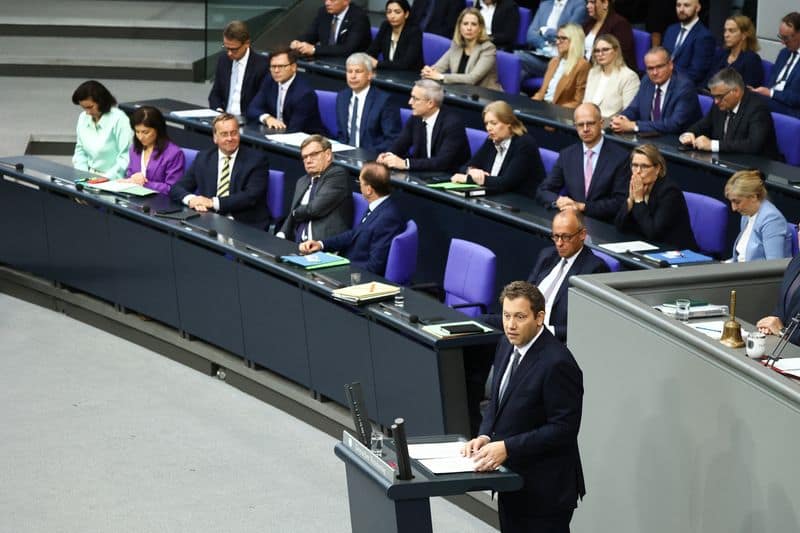
Germany's Finance Minister Lars Klingbeil asserted that the nation cannot adequately defend itself without incurring new debt, a stance he presented while defending the 2027 draft budget. This push for increased defense spending comes amid heightened global threats and pressure from U.S. President Donald Trump for NATO allies to increase their contributions.
Klingbeil likened the necessity of borrowing for defense to 'flying to the moon without a rocket,' emphasizing that such investments are crucial for Germany's future security and operational capability. The draft budget outlines a significant ramp-up in investment and defense spending, aiming to bolster the economy against war-related shocks and address years of underinvestment. From 2027 to 2030, Germany plans to borrow a total of €838.2 billion ($973.23 billion), a move that faces opposition due to historical experiences with hyperinflation.
Despite opposition, Klingbeil defended the borrowing, criticizing opponents for neglecting infrastructure for years. He highlighted that total investment is set to rise to €117.5 billion in 2027 from €78.9 billion in 2025, supported by a €500 billion infrastructure fund and relaxed borrowing rules for defense.
The ruling coalition recently suffered an election defeat in Saxony-Anhalt, where the far-right Alternative for Germany (AfD) secured first place. This outcome has reopened divisions within Chancellor Friedrich Merz's government, with Klingbeil's SPD advocating for softened economic and social reforms. Klingbeil explicitly rejected racism and exclusionist policies, vowing to prevent the dismantling of the welfare state and protect social rights.
Core defense spending is slated to increase to €109 billion in 2027 from €82.2 billion in 2026, with total security spending reaching €130.1 billion, including support for Ukraine. Klingbeil clarified that Germany's defense investments are not for waging war but for preventing its experience, noting that Russia's aggression extends beyond Ukraine's borders. He stated Germany would not be intimidated by Russian President Vladimir Putin.
Furthermore, Klingbeil argued that these funds would help revive Germany's sluggish economy. Despite challenges like higher prices due to the Iran conflict and U.S. tariffs, the German economy grew by 0.3% in the second quarter. Several economic institutes have revised their growth forecasts upward for 2026 and 2027, attributing the stronger-than-expected recovery in the first half of the year to increased government spending.
In parallel, Germany will send additional Patriot air defence missiles to Ukraine, Defence Minister Boris Pistorius announced. He warned that Russia is likely to intensify its air campaign against Ukrainian infrastructure as winter approaches, stating that Patriot missiles are currently the only effective defense against Russian ballistic missile attacks on Ukraine. NATO Secretary General Mark Rutte also pressed allies to increase support, saying civilian casualties from the war were at their highest level since May 2022. Ahead of the meeting, Rutte and European Commission President Ursula von der Leyen said EU member states had agreed to use part of a €90-billion ($105 billion) EU loan to allow Ukraine to buy crucial supplies for Patriot systems.