Key facts
- Fruit flies navigate by smell using an "edge tracking" strategy, not simple reflexes.
- A virtual reality system allowed researchers to precisely control odor plumes and fly behavior.
- Flies maintain orientation using a neural compass and update stored memories of scent locations.
- The research challenges the long-held "surge and cast" model of insect olfactory navigation.
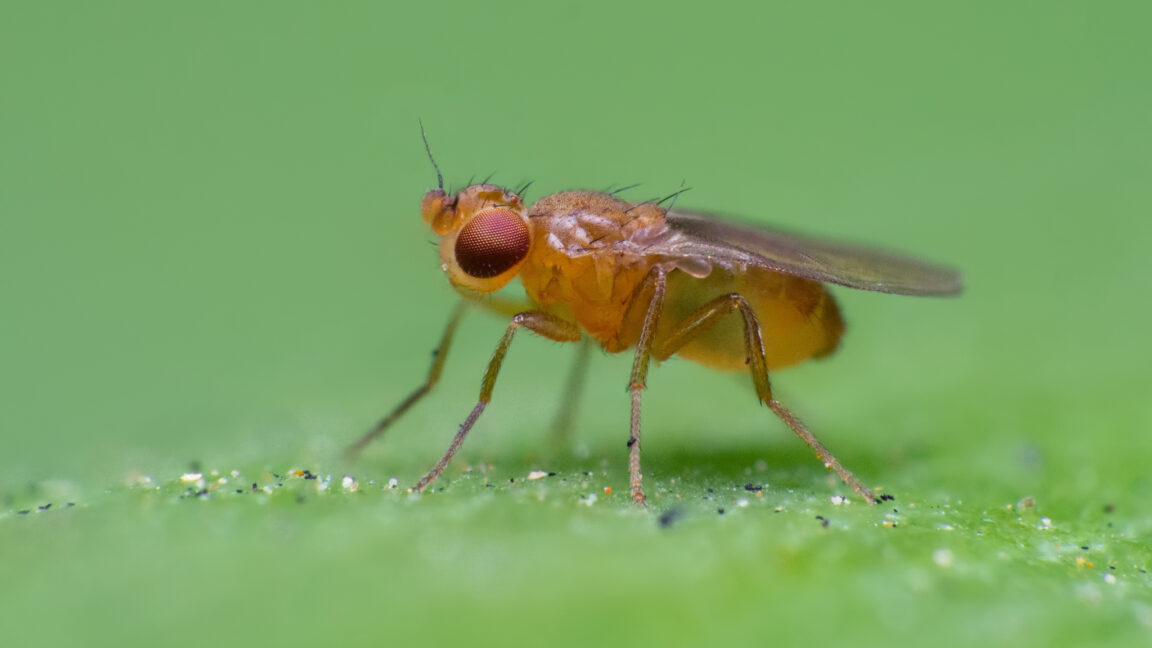
Fruit flies navigate complex olfactory landscapes by employing a sophisticated memory-based strategy rather than simple reflexes, according to new research led by Vanessa Ruta at Rockefeller University. Previously, scientists believed insects used a "surge and cast" model, involving flying upwind until a scent disappeared and then searching side-to-side. However, Ruta's team developed a unique experimental setup using a fly-sized treadmill in complete darkness. This system allowed researchers to precisely control odor delivery and simulate lifelike olfactory experiences, enabling them to observe the flies' behavior in detail.
In experiments with a straight corridor of apple cider vinegar, flies did not fly directly up the middle. Instead, they engaged in "edge tracking," hugging the boundary of the scent plume. Upon crossing into the odor, they would briefly turn back out into clean air before returning to the edge. This behavior occurred even when the odor concentration decreased along the direction of travel, ruling out simple gradient climbing.
Further investigation revealed that flies possess stored olfactory memories. When a plume vanished, the flies continued to head towards where the scent should have been, indicating they were guided by an internal map. Neurons in the central complex acted as a compass, maintaining the fly's orientation to the wind, while neurons in the fan-shaped body encoded memories of the plume's edge position. Silencing these neurons impaired the flies' ability to navigate. The research also demonstrated that flies could rapidly update these olfactory memories when the direction of the scent plume was altered, reinforcing the idea of a dynamic, memory-driven navigation system.