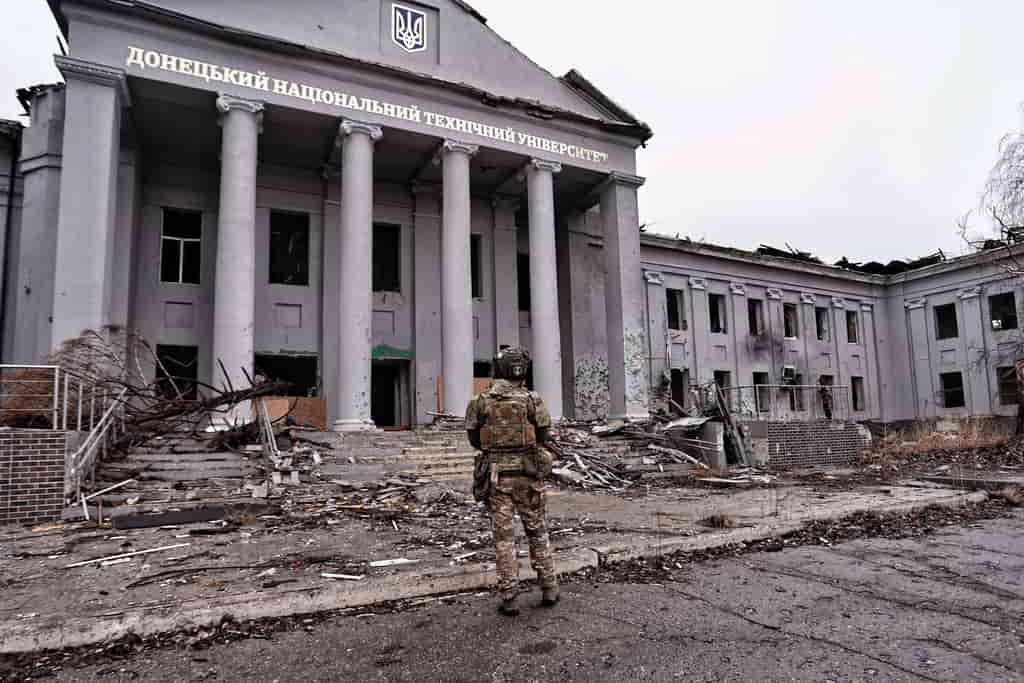
Key facts
- The Vasyl Stus Donetsk National University (DonNU), originally from Donetsk, is now based in Vinnytsia, Ukraine.
- The university expects a 50% increase in student enrollment for the upcoming academic year.
- Students are relocating from eastern Ukrainian cities facing increased Russian missile attacks.
- DonNU was relocated in 2014 after Russian-backed proxy forces seized its buildings.
- The university has adapted to displacement by implementing online classes and preparing for infrastructure attacks.
The Vasyl Stus Donetsk National University (DonNU), one of Ukraine's first relocated higher education institutions, is preparing for its 12th academic year in Vinnytsia, anticipating a significant 50% increase in student enrollment. This influx is attributed to students fleeing missile-battered cities in eastern Ukraine and seeking safer environments for their studies.
DonNU was originally based in Donetsk but was forced to relocate in 2014 when Russian-backed proxy forces seized its administrative buildings and dormitories. The university's rector, Illia Hadzhinov, described the initial relocation as difficult, with student numbers dropping to less than half of its previous enrollment of nearly 12,000. However, the university has since adapted, introducing online classes and preparing for potential Russian attacks on energy infrastructure, drawing on its experience with occupation and displacement.
Professors like Kostiantyn Rodyhin and Serhii Radio recall the challenging beginnings in Vinnytsia, where staff worked with minimal resources in a former jewelry factory. Despite these hardships, the university has grown into a new entity, with enrollment numbers now approaching pre-full-scale invasion levels. Many students are choosing DonNU not only for safety but also due to a personal connection to Donetsk Oblast, with some seeing the university as a continuation of their regional identity.
The university's name honors Vasyl Stus, a prominent dissident born in the Vinnytsia region who later studied in Donetsk. The architectural parallels between the university's buildings in Donetsk and Vinnytsia are also noted, further strengthening the connection between the two regions. While the university operates in Vinnytsia, its faculty and students remain carriers of the Donetsk identity.