Key facts
- China's new-energy vehicle (NEV) sales accounted for over 60% of total new car sales in July.
- Domestic car sales in China declined by 20% in July compared to the previous year.
- Chinese car exports surged by 88% in July, reaching 923,000 vehicles.
- Chinese automakers have significantly increased their market share in Europe, especially in the EV segment.
- Leading Chinese carmakers are facing a strategic necessity to expand globally due to weak domestic demand.
China's automotive industry is experiencing a significant divergence, with new-energy vehicle (NEV) sales now comprising over 60% of the domestic market in July, bolstered by surging export volumes. This robust international performance is compensating for a sharp downturn in China's home market, where weak consumer demand and intense price competition have led to a glut of excess capacity.
Automakers like BYD, Geely, and Chery are increasingly turning to overseas markets not only out of ambition but also economic necessity. Analysts note that Chinese automakers possess excess manufacturing capacity, competitive supply chains, sophisticated products, and a strong economic incentive to seek growth outside China.
In July, China's car sales fell by 20% year-on-year to 1.47 million vehicles, marking the tenth consecutive month of decline. Conversely, exports soared by 88% to 923,000 vehicles. This trend is evident even when excluding non-Chinese brands produced in China.
The China Passenger Car Association attributed the domestic weakness to elevated fuel prices and a soft entry-level sedan segment. More broadly, the situation reflects China's economic dynamic of strong factory output and exports supporting growth while domestic consumption remains subdued.
In the first half of the year, China's domestic car sales dropped by 2.3 million vehicles, equivalent to Japan's total domestic new car registrations for the same period. Meanwhile, Chinese car exports jumped 71% in the first half. HSBC analyst Yuqian Ding anticipates a stabilization and potential recovery in domestic demand from late August, though a V-shaped rebound is unlikely.
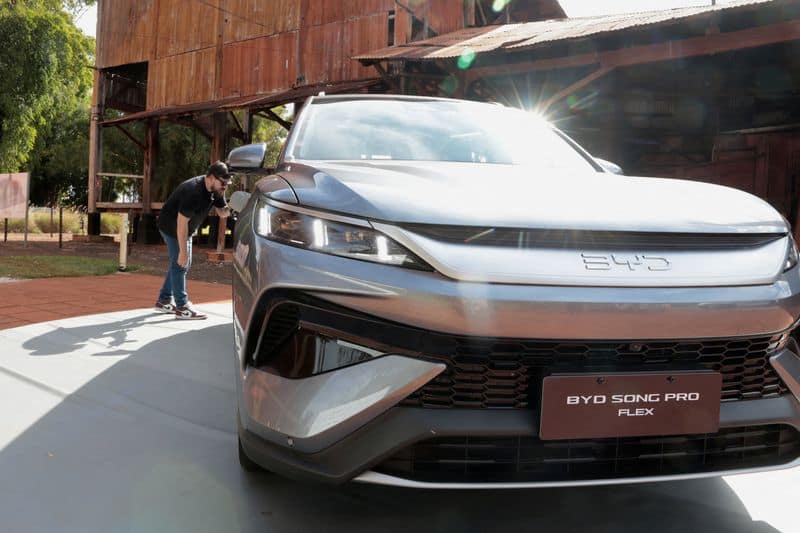
BYD, for instance, has seen its domestic sales slump 35% in the first seven months of the year, but its overseas sales surged 79% year-on-year, with Brazil and Britain becoming key markets. China's rise as the world's largest vehicle exporter, a title previously held by Japan, is attributed to its advantages in electrification, batteries, software, intelligent features, supply-chain scale, and rapid product development, making its globalization potentially more disruptive.
Chinese players are exerting significant pressure in overseas markets. In Europe, Chinese automakers' market share in passenger vehicles grew from 3% to 16% in the first quarter of 2026, while Japanese automakers' share remained around 12%. The gap is particularly pronounced in EVs, where Chinese brands account for nearly a quarter of Europe's EV shipments, compared to less than 5% for Japanese automakers. Counterpoint Research forecasts Chinese brands will capture over 20% of Europe's overall passenger vehicle market and 29% of its EV market by 2030, with tariffs expected to slow but not reverse this trend.