Key facts
- South Korea's Kospi index fell over 7% Tuesday to its lowest level since July 31.
- Samsung Electronics and SK Hynix shares dropped 9% and 10% respectively.
- Concerns over Chinese competition in AI and financing of infrastructure buildouts are weighing on investors.
- Broadcom CEO Hock Tan warned that capital, not chips or electricity, could be the biggest constraint on AI industry growth.
- The Kospi was the world's best-performing major stock index in the first half of 2026 before tumbling in the second half.
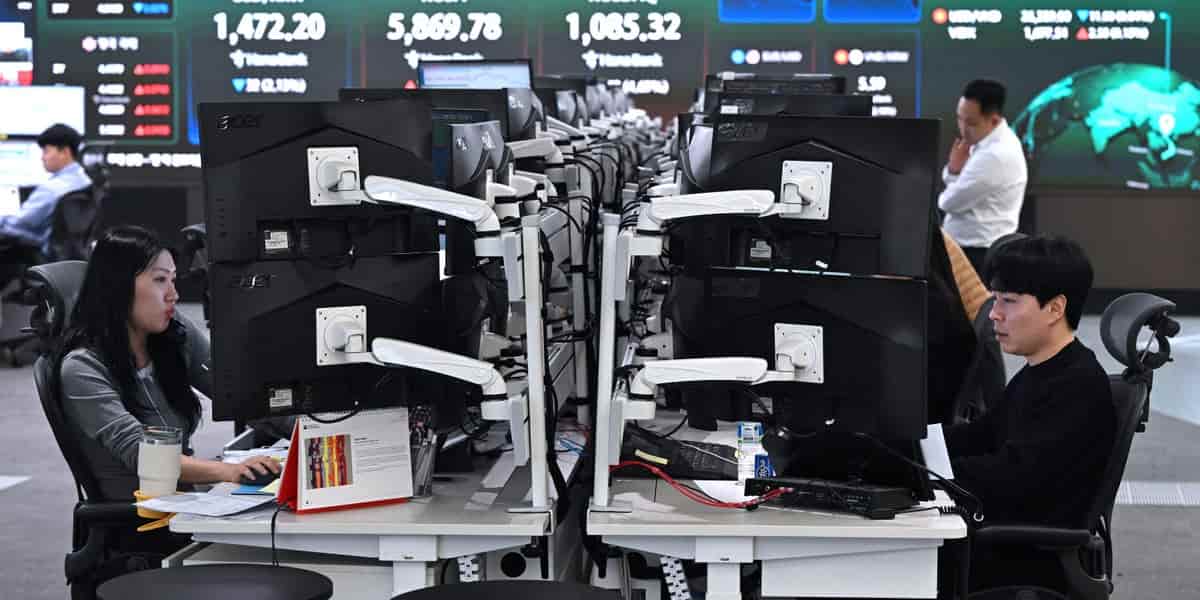
South Korea's stock market experienced a significant plunge on Tuesday, with the benchmark Kospi index falling more than 7% intraday to its lowest level since July 31. This marks a dramatic reversal for a market that was once a leading performer in the AI-driven stock rally.
AI chip giants Samsung Electronics and SK Hynix were at the forefront of the decline, with shares dropping 9% and 10% respectively by midday. The weakness was not isolated to South Korea, as Japan's Nikkei and Taiwan's chip-heavy Taiex also fell around 3%, following a weak session for US semiconductor stocks overnight.
Investors are grappling with a growing list of concerns surrounding the AI trade. These include intensifying competition from China and uncertainties about the financing required for the industry's substantial infrastructure buildout. Chris Weston, head of research at Pepperstone, highlighted China's expanding ambitions in the AI ecosystem as a key catalyst for the recent selloff. He pointed to announcements from Chinese memory-chip maker CXMT regarding progress in developing technology that could increase data capacity on memory chips and plans for a new server-memory product by year-end.
While CXMT has yet to prove its technology can be manufactured at scale and does not immediately challenge South Korea's dominance in high-bandwidth memory chips for AI accelerators, the development has heightened investor worries about the longevity of memory makers' pricing power. The selloff represents another setback for the Kospi, which had been the world's best-performing major stock index in the first half of 2026 before experiencing a downturn in the latter half as investors shifted focus to other segments of the AI hardware supply chain, such as Taiwan.
Further compounding these concerns, Broadcom CEO Hock Tan issued a warning on Monday that capital, rather than chips or electricity, might become the primary bottleneck for the AI industry's expansion. These combined factors suggest that investors are now scrutinizing not only AI demand but also the industry's pricing power and profit margins. Weston noted that China's capacity to produce increasingly competitive technology at lower costs is "challenging established assumptions around market share, pricing power and the durability of margins."