
Key facts
- China aims to increase its intelligent computing capacity more than fourfold by 2030.
- The US has blocked China from importing advanced Western-made AI chips.
- Huawei plans to connect up to 15,488 Ascend chips into unified systems.
- Huawei's Ascend 950PR chip is slated for market release in Q1 2026.
- China's Cyberspace Administration advised against purchasing specific Nvidia AI chips in September 2025.
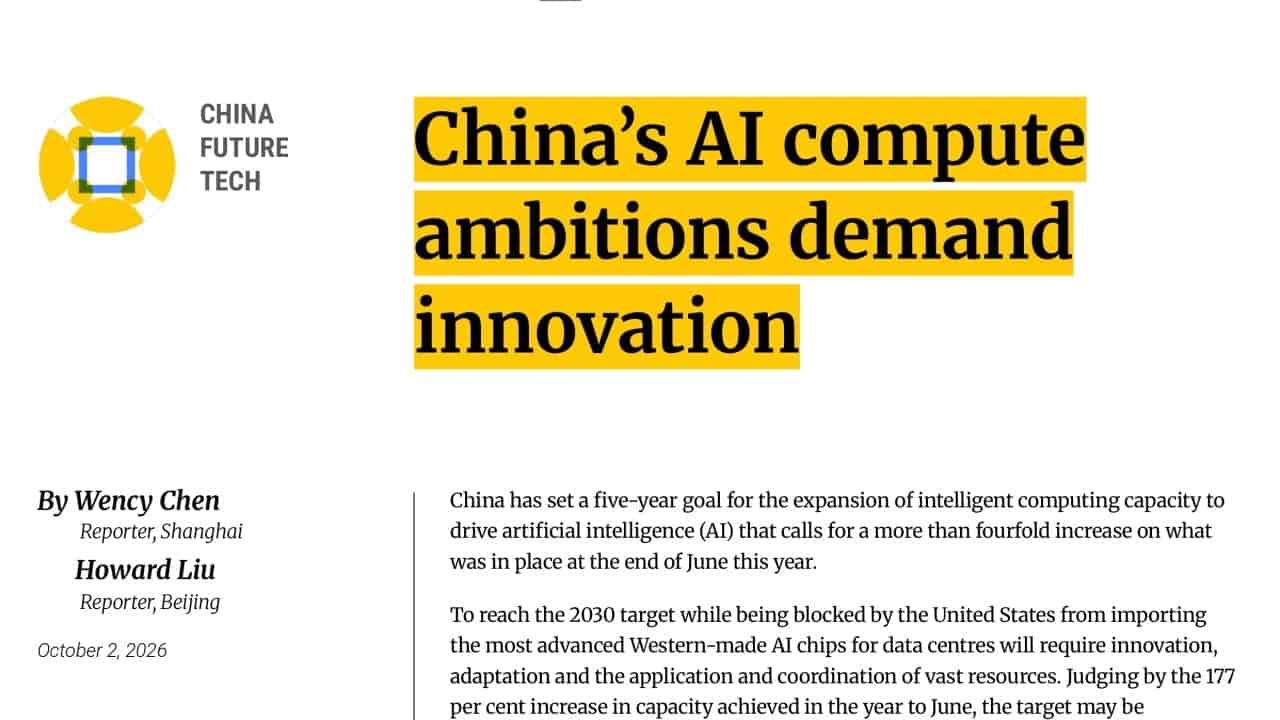
China has set an ambitious goal to more than quadruple its intelligent computing capacity by 2030, a move aimed at driving its artificial intelligence development. This expansion is crucial for China to compete globally in AI, a field seen as vital for national power, economic growth, and technological independence.
However, the country faces significant hurdles, particularly US restrictions on importing the most advanced Western-made AI chips. To overcome these limitations, China is focusing on innovation, adaptation, and the coordinated application of vast resources. The nation has already achieved a 177% increase in capacity in the year leading up to the end of June, indicating a strong drive toward its target.
Huawei, a key player in China's tech sector, has revealed plans for its Ascend AI chips and SuperPod computing clusters. The company's strategy emphasizes scale, connecting thousands of chips into unified systems that function like supercomputers, potentially compensating for individual chip performance limitations. Huawei announced that its Ascend 950PR chip is expected to be released in the first quarter of 2026 as part of a multi-year roadmap.
In September 2025, China's Cyberspace Administration signaled a move away from foreign suppliers by advising domestic companies against purchasing specific Nvidia AI chips, such as the H20 and RTX Pro 6000D. This directive underscores China's commitment to fostering its own AI ecosystem. Other Chinese tech giants, including Alibaba, Tencent, and Baidu, are also developing their own AI chips, with Alibaba's T-Head subsidiary reportedly creating a chip comparable to Nvidia's H20.
This push for domestic capabilities is part of a broader national strategy to build a self-sufficient semiconductor industry, especially since Huawei was blacklisted by the US in 2019. The country is investing in domestic foundries and chipmaking tools to create a resilient supply chain. The success of Huawei's clustering strategy could challenge Nvidia's market dominance, particularly in regions prioritizing scalability and cost-effectiveness, potentially leading to a split in global technology standards.