Key facts
- Gukov said his models had solved a few of the problems before OpenAI did.
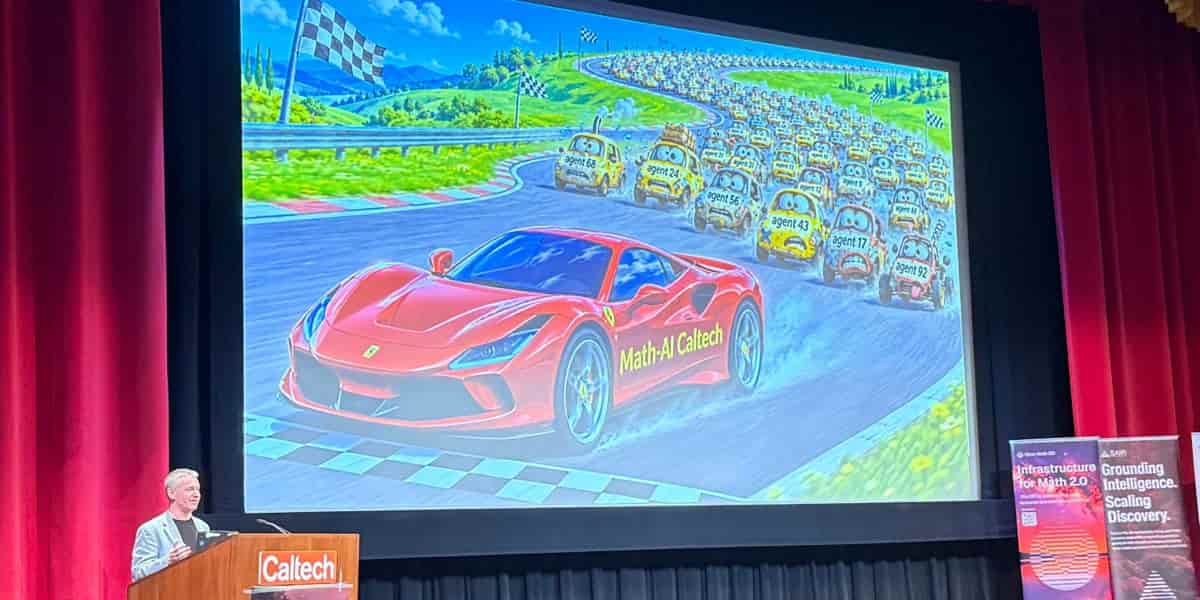
- Gukov likened his models to Ferraris, saying most can solve only one specific math problem.
- Gukov said a more generalized model is in the works but is not ready.
- Tasmin Chu, a Caltech Ph.D. math student, called mathematician-created AI an effort to own the means of production.
- Terence Tao, a mathematician at UCLA, has advocated that mathematicians create their own AI systems.
- Tao's Open Math OS provides access to open-source frontier AI models, cloud computing and collaborative tools.
Sergei Gukov, a professor at Caltech, runs a lab where he and a handful of students design and build their own open-source AI models from scratch, specifically engineered to solve math problems, Business Insider reported on November 19, 2026. Gukov said he could see the writing on the wall, and that when OpenAI in October solved hundreds of famously thorny math questions, he was not surprised. He said his own models had solved a few of them first.
"The more we work with the systems, the more we understand them," Gukov told Business Insider. "As a result, the better we can control them." He likened his models to Ferraris, luxury cars that are largely inaccessible to the general public. Most of his models can only solve one specific math problem, he said, and would sputter if asked to branch out. By comparison, Anthropic models can handle math prompts across a variety of disciplines, according to the report. Gukov said a more generalized model is in the works but is not ready yet.
The approach is drawing attention in the math community at a time when antipathy toward major AI companies is high, as the companies rapidly publish solutions without running them by academic luminaries, the report said. Mathematicians have criticized OpenAI's approach in Substack essays and lecture halls, saying the companies are exploiting their field to drum up hype for an IPO and that many of the proposed solutions are meaningless unless a human researcher spends weeks deciphering how they were reached.
Tasmin Chu, a Ph.D. math student at Caltech who runs a popular anti-AI Substack, called mathematician-created AI systems an effort by mathematicians to "own the means of production." "It's complex," she told Business Insider. "I guess it depends on how it really plays out." Chu said she is invested in it remaining viable to do mathematics without AI at all.
Terence Tao, a mathematician based at UCLA, has repeatedly advocated that mathematicians create their own AI systems. At Caltech on Friday, November 13, 2026, he demoed a platform created by a nonprofit he founded. The Open Math OS, as the makers call it, provides access to open-source frontier AI models, cloud computing and collaborative tools, and allows mathematicians to control how their data is used, according to the report. The data issue has been important since two mathematicians accused OpenAI of using their chat logs to help solve the Navier-Stokes problem, the report said.