Key facts
- Nvidia ended Wednesday's session down 3.9% at $149.30, $2.3 trillion below its October peak of $243.37.
- S&P placed Nvidia's credit rating on watch for a possible downgrade, citing management and board oversight weaknesses.
- The White House proposed new tariffs on 14 major trading partners, and the duties will not stack on those imposed in July.
- Futures imply a 98% chance the Fed will raise rates by 25 basis points in December, per the report.
- Brent futures rose 0.2% to $94.81 a barrel after Yemen's Houthis said they attacked Saudi Arabia's largest oil refinery.
- The dollar index eased to 103.71 and the dollar slipped to 0.8311 francs.
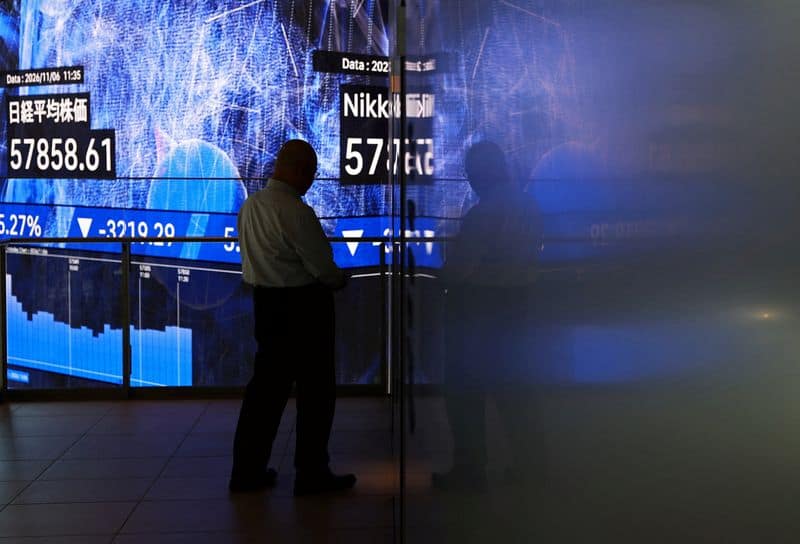
Japan's Nikkei gained 1.6% and South Korea's main index rose 1.9% on November 26, 2026, while Asia-Pacific shares outside Japan edged up 0.6% in a holiday-thinned session, according to Reuters. Japan is down 8% for the month, South Korea has shed 16% and Taiwan 15%, and Asia-Pacific shares outside Japan were still off 9% for November.
Nvidia was again at the center of the unease after S&P put its credit rating on watch for a possible downgrade, citing weaknesses in the chipmaker's management and board oversight. Nvidia stock ended down 3.9% at $149.30 on Wednesday, $2.3 trillion short of its October peak of $243.37. Wall Street recouped most of its initial losses overnight as money moved into more defensive sectors, and S&P 500 futures added 0.5% early on Thursday while Nasdaq futures firmed 0.4%.
Treasury yields hit multi-week lows on Wednesday even as US economic growth for the third quarter was revised up sharply to 4.3% and the Federal Reserve's favored measure of core inflation hit 3.3%. Futures still imply a 98% chance the Fed will raise rates by 25 basis points in December, and speculation of a half-point increase has faded. Yields on 10-year paper were off at 4.848%, having touched an 11-week trough overnight.
The inflation outlook was not helped by White House proposals for new tariffs on 14 major trading partners including China, Japan and the European Union, though the new duties will not stack on top of those imposed in July. "The latest US tariff announcement is not as alarming as it looks, and the increase in the effective tariff rate looks set to be a touch lower than we've been assuming," said Stephen Brown, chief North America economist at Capital Economics. "The additional tariff burden is likely to be small, but will still provide a marginal boost to prices and keep core goods inflation firm into next year."
In currencies, the dollar index eased a touch to 103.71 as Treasury yields fell. The Swiss franc gained as the dollar slipped to 0.8311 francs, the euro inched up to $1.0973 from its recent low of $1.0881, and the dollar held steady on the yen at 159.14.
In commodities, Brent futures rose 0.2% to $94.81 a barrel and US crude futures added 0.6% to $84.24 a barrel after Yemen's Houthis said they had attacked Saudi Arabia's largest oil refinery. Gold eased 0.4% to $3,566 an ounce, having fallen almost 8% so far this month.