Key facts
- MSCI's broadest Asia-Pacific index lost 2.5% on Friday and was down 7% for the week, its worst since March 2020.
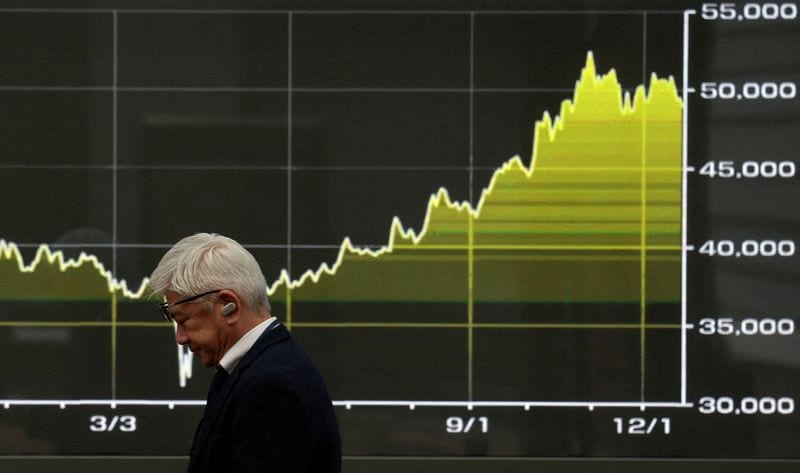
- Japan's Nikkei 225 fell 4.1% on Friday and was headed for a 6.8% weekly decline.
- South Korea's KOSPI fell 4.7% on Friday and was set to end the week 7.5% lower.
- Anthropic's shares rose more than 30% in its debut, but the gain did not lift other AI-related stocks.
- The dollar index last traded steady at 103.86, after hitting its strongest level since April 2025 this week.
- Brent crude futures settled flat at $91.98 a barrel, on track for a third straight weekly decline.
Asian shares slid on Friday, November 20, 2026, putting the region on track for its worst week since 2020, as Anthropic's market debut failed to restore investor confidence in AI-related trades. MSCI's broadest index of Asia-Pacific shares lost 2.5% and was set for a six-day losing streak, down 7% for the week, its worst performance since March 2020, Reuters reported.
Japan's Nikkei 225 fell 4.1% and was headed for a 6.8% weekly drop, while South Korea's KOSPI fell 4.7% and was set to end the week 7.5% lower. The moves in Asia followed losses of more than 2% for the S&P 500 and the Nasdaq Composite. Earlier, Yonhap News Agency reported the KOSPI opened 209.38 points, or 4.08%, lower at 4,928.51, tracking overnight US losses.
Anthropic, described by Reuters as the world's first publicly traded frontier AI company, saw its shares rise more than 30% in its debut, but the gain did not lift other AI-related stocks. "Anthropic's blockbuster IPO proved not enough to assuage the overall concern about the outlook for the AI trade and equities more broadly," said Kyle Rodda, senior financial market analyst at Capital.com.
Reuters reported that the wider AI sector has been hurt by the exit of Jensen Huang from Nvidia, additional momentum for the anti-data-center movement after the Democrats' sweep of the US midterm elections, unease about mounting debt loads in the sector and warnings that AI threatens human extinction. Rodda said that with the AI trade fading and Fed rate hikes seen likely, market sentiment is shaky and the risk is that bearishness drags stocks lower.
US stock futures pointed to further losses, with S&P 500 futures down 0.4% and Nasdaq futures down 0.7% in Asia on Friday. The dollar extended its rally, with the dollar index last traded steady at 103.86 after hitting its strongest level since April 2025 this week. Fed funds futures imply a quarter-point rate hike next month is essentially locked in, according to CME Group's FedWatch tool.
US Treasury yields eased as the equity selloff pushed investors toward government bonds. The yield on benchmark 10-year Treasury notes held steady at 5.026%, near a one-week low, while the two-year yield touched 4.749%, compared with a US close of 4.779%. Oil prices were mostly steady after an earlier spike, as reports of tanker disruptions in the Strait of Hormuz offset pressure from rising US crude inventories and forecasts for a global oil surplus. Brent crude futures settled flat at $91.98 a barrel, on track for a third straight week of decline. Gold dipped 0.6% to $3,601.40 an ounce and was headed for a 7.3% weekly loss.