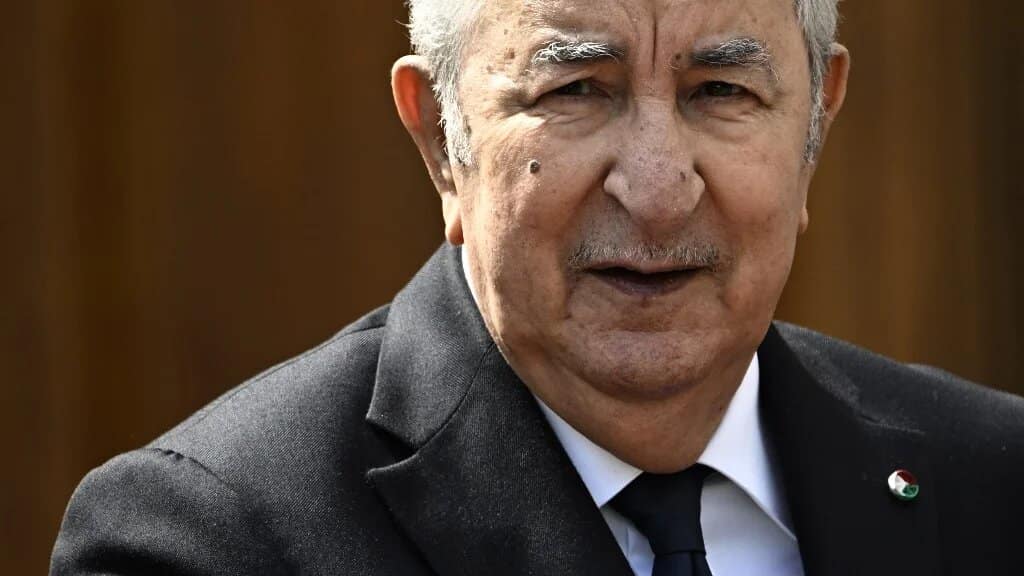
Algeria announced on Thursday it was severing diplomatic relations with the United Arab Emirates, a move stemming from a complex web of geopolitical disagreements that have increasingly been framed by Algiers as a national security threat. While disputes over issues like Western Sahara, Israel, Libya, and the Sahel had persisted for years, a shift in the bilateral relationship from late 2023 onwards appears to have precipitated the rupture.
Previously, Algeria had maintained bilateral cooperation with the UAE despite opposing its regional policies. This included hosting joint military and economic commission meetings in early 2023, with officials even discussing a possible strategic partnership. Political contacts also continued, with President Abdelmadjid Tebboune and UAE President Mohammed bin Zayed exchanging brief words at the G7 in Italy in June 2024, months after tensions had become public.
The UAE's opening of a consulate in Laayoune in 2020, supporting Morocco's claim over Western Sahara while Algeria backs the Polisario Front, and its normalization with Israel and support for Khalifa Haftar in Libya, had not previously impeded cooperation.
However, the separation between regional policy opposition and bilateral ties became harder to sustain from late 2023. Media close to the Algerian government attributed Algeria's exclusion from the expanded BRICS grouping to Emirati maneuvering. More significantly, Algeria's declining leverage in Mali, where the UAE has developed security cooperation with Bamako, became a focal point. The collapse of the 2015 peace agreement in Mali, brokered by Algeria, reduced Algiers' influence and weakened its immediate security environment, with the UAE's growing security footprint in the region viewed as encroachment.
The dispute entered Algeria's highest national-security institution in January 2024, with the High Security Council denouncing hostile acts by an unnamed 'brotherly Arab country.' Concerns also extended to internal matters, with state media portraying a foreign broadcast critical of Amazigh identity as an attack on national unity. By May 2025, President Tebboune explicitly accused an unnamed Gulf state of interfering in Algerian elections and threatened international arbitration over Emirati investments.
Despite the diplomatic rupture, economic ties show a lag in complete disengagement. Instructions were given to halt transactions involving Algerian-Emirati tobacco partnerships, but other arrangements, such as DP World's operations and a joint automobile manufacturing venture, remain. This suggests a difference in tempo between political redefinition and unwinding long-standing contracts. Similarly, while Algeria began terminating its air services agreement, flights continued during a notice period, and commercial flights were temporarily exempted from airspace closure until the end of 2026.
The timing of the September decision is not solely explained by the Mali situation, as relations between Algeria and Mali had improved. President Tebboune indicated in July that a rupture with the UAE had been a political option for some time, suggesting it did not require a single new trigger but rather a broader redefinition of the relationship within Algeria's national security and domestic sovereignty concerns.