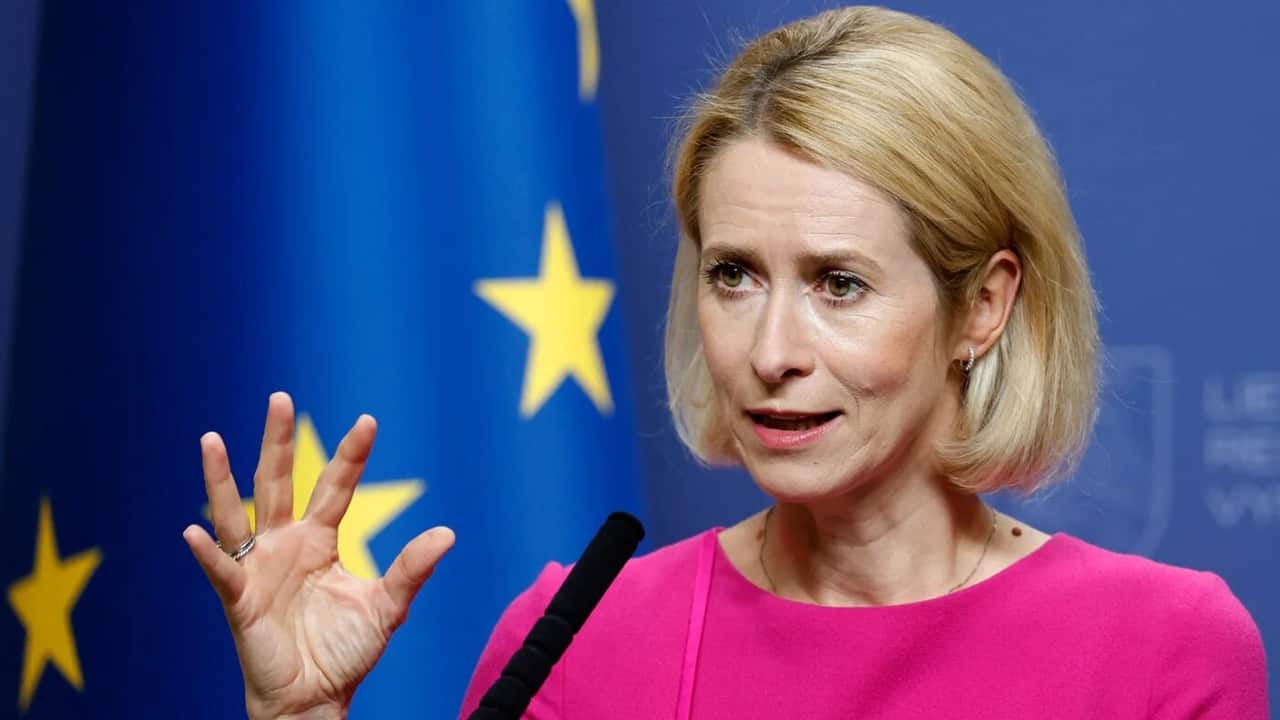
European Union foreign policy chief Kaja Kallas stated that the EU should ban trade with Israeli settlements in the occupied Palestinian Territories, drawing a parallel to the EU's response to Russia's annexation of Crimea. Kallas urged member states to adopt a "principled stance" on the issue, which she believes is illegal under international law.

The EU's foreign policy chief's call for a trade ban on Israeli settlements, drawing parallels to sanctions on Russian-occupied Crimea, signals a potential shift in the bloc's approach to the Israeli-Palestinian conflict. Such a move could have significant implications for international trade relations and further isolate Israel, while also testing the unity of EU member states on foreign policy m
European Union foreign policy chief Kaja Kallas has stated that the EU should treat illegal Israeli settlements in the occupied Palestinian Territories in the same manner as it treated Russia's invasion and annexation of Crimea. Kallas urged European governments to adopt a 'principled stance' and support an EU-wide ban on trade with these settlements, which she believes is illegal under international law.
Kallas told The Irish Times that while the volume of trade with settlements is small, a ban would send an important symbolic message. She noted that if approved as a trade measure, it would require a majority of member states' support, unlike sanctions which currently face opposition from Germany, Hungary, the Czech Republic, and Slovenia. Kallas also indicated that the European Commission is under pressure from national governments to propose such a ban.
"The question is what do we do about this? If we take the example when Crimea was occupied, then it was very clear, it’s illegal, we don’t recognise this, which means that we stop the trade with any products that come from Crimea," Kallas said. "We should have the same principled stance - you know this is illegal, everybody agrees - so we should stop trading with occupied [Palestinian] Territories."
This development follows the UK's announcement of sanctions on Israeli settlements on September 8, with ten other European countries and Canada joining Britain in a statement to "confirm their intention to introduce national and/or support European restrictions" on illegal settlement trade. In response, Israeli Foreign Minister Gideon Saar announced counter-sanctions, including the closure of the British consulate in occupied East Jerusalem and a ban on 11 British MPs entering Israel. US ambassador to Israel Mike Huckabee also criticized the UK's move, accusing Foreign Secretary Ed Miliband of "Jew hate."
Israel's approval of the E1 settlement project in August, which plans to build 3,400 new housing units on occupied Palestinian territory, has drawn widespread international condemnation. Kallas has reportedly privately compared Israel's treatment of Palestinians to apartheid South Africa, a stance that contrasts with her previous public statements of solidarity with Israel.