By Jarrett Renshaw and Trevor Hunnicutt
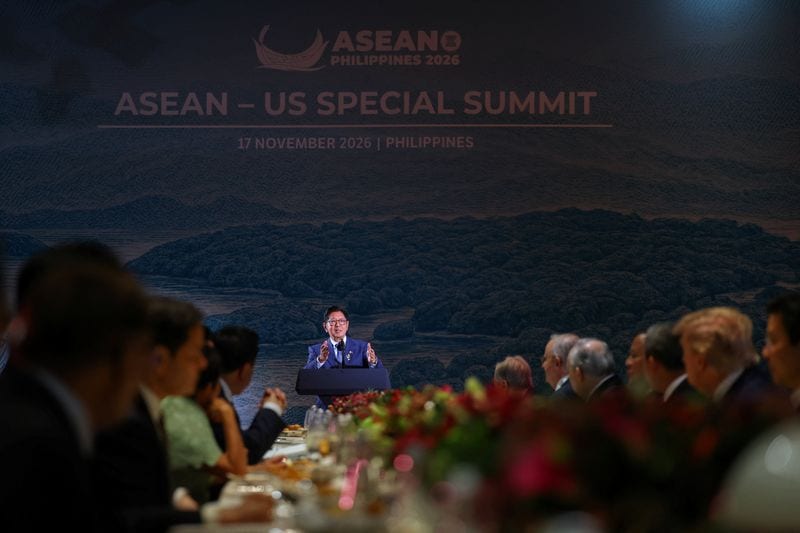
MANILA/SHENZEN, China, Nov 18 (Reuters) - US President Donald Trump will meet Philippine President Ferdinand Marcos Jr. on Wednesday before heading to China for high-stakes talks with his Chinese and Russian counterparts, seeking to advance US interests in Asia while navigating tensions with Washington's biggest strategic rival.
Trump's meeting with Marcos at the presidential palace in Manila will give the Philippine leader an opportunity to press for stronger US security commitments as China steps up its activities in the disputed South China Sea.
The two leaders are scheduled to hold bilateral talks and a working lunch before Trump departs for Shenzhen, in southern China.
Trump arrived in Asia reeling from a bruising midterm election in which Republicans suffered sweeping defeats, raising questions about his domestic political standing. His meetings with regional leaders and, most consequentially, Chinese President Xi Jinping will test whether he can still project strength and wield leverage on the world stage.
FRICTION IN THE SOUTH CHINA SEA
On Tuesday Trump kicked off his Asia trip with his first meeting with leaders of the Quad, the Indo-Pacific grouping of the United States, Japan, India and Australia.
That agenda included critical minerals that drive high-tech industries, maritime security, and artificial intelligence.
As the Quad leaders gathered, Trump told reporters that he wanted to ensure the future of AI was shaped by countries that shared US values.
The engagements will be closely watched for signs of Washington's commitment to the Indo-Pacific, as allies seek reassurance about US security and economic engagement in a region where China remains a dominant trading partner.
For Marcos, one of Washington's closest security partners in the region, the talks come amid growing friction with Beijing over competing claims in the South China Sea. The Philippines has sought clearer assurances about US willingness to defend Philippine forces and vessels in the disputed waters.
Trump will later travel to Shenzhen for Thursday's meeting with Xi on the sidelines of the Asia-Pacific Economic Cooperation summit. The two leaders are expected to discuss trade and economic relations, with China's restrictions on rare earth exports and US curbs on advanced semiconductor sales among the central issues.
MEETING WITH NORTH KOREA'S KIM?
Trump has also floated the possibility of meeting North Korean leader Kim Jong Un, saying he had asked Xi to help arrange an encounter. No meeting has been confirmed, and North Korea has shown little interest in renewed diplomacy.
"He may come. I don't know. That's up to President Xi," Trump told reporters before leaving Washington on Monday.
Trump was expected to bring Elon Musk, the billionaire head of Tesla and SpaceX, to China, where his companies have significant commercial interests. Mastercard CEO Michael Miebach and FedEx CEO Raj Subramaniam were also expected at APEC-related events, according to people familiar with preparations.
Jensen Huang, who has been a regular participant in high-profile gatherings involving Trump and Asian leaders, is not expected to join the delegation after he resigned as Nvidia's chief executive amid allegations that a woman with whom he had a relationship had ties to Chinese intelligence. Huang has denied wrongdoing. Trump said before leaving Washington that he would support Huang getting his job back.
The controversy adds sensitivity to discussions over US restrictions on advanced AI chips and China's access to the technology.
Trump is also scheduled to take part in a trilateral meeting with Xi and Putin on Thursday, bringing together the leaders of three major nuclear powers. Trump has said the discussions could address nuclear arms control and Iran, while the war in Ukraine could also feature. Officials and analysts have played down the prospect of major agreements.
The meeting could unsettle US allies, who are watching Trump navigate ties with two of Washington's biggest strategic rivals.
“His willingness to engage in this manner suggests an openness to the idea of a US-China-Russia ‘G3’,” said Oleg Ignatov, senior Russia analyst at the International Crisis Group. “His interest in such arrangements unnerves US allies and partners, who question how their interests will fare if these three powers try to manoeuvre around and above them.”
(Editing by Alex Richardson)